

Bluefin Gear
Fishing bluefin is like playing a round of golf. Golfers need specific golf clubs for each section of the greens, anglers need a set of outfits for each type of bluefin bite. A good ‘starter kit’ for local bluefin would be a 30, 40, 60, and 80-pound class outfits. While a two-speed reel is not necessary on your thirty-pound outfit, the forty thru eighty-pound outfits need to be lever drag two speed reels. If I wanted to add to this quiver, I would include a jig stick for throwing poppers and surface iron and another rail rod outfit with #100 lb. line.
Most west coast sport boats that are targeting bluefin will have their own ‘kite outfits’ onboard for anglers to use on the kite rotation. The crews have these outfits rigged properly for the kite and it is one less heavy outfit to bring on the trip. For the private boat set, the options are endless. If your style of fishing is on the rail, I recommend the Seeker OSP 2 x 4 or 3X and a thirty or fifty size two speed reel loaded with 100/130-pound braid. On my boat we like the challenge of a standup battle and use a Seeker Black Steel 6465XH rod paired with a PENN International 50 or 70VISX reel and 50/80 lb. line. The six- and half-foot rod when combined with an AFTCO bucket harness is deadly on big tuna.
 On this ‘bluefin starter kit’ the outfit that seems to be most versatile and has other fishing applications is the forty-pound outfit. My ‘go-to’ forty-pound outfit is a PENN Fathom 30 two speed lever drag reel filled with #65-pound braid and a hundred-foot top-shot of forty-pound Big Game monofilament. Paired with Seeker 6470-7’ rod, it is a great heavy bait rod and can send a sardine on a flight off the corner or bow. After tuna season, this outfit doubles as a ‘yo yo’ outfit for yellowtail in the spring. I also bring it down to Baja in the fall for school tuna, dorado, and wahoo. A perfect all-around outfit for many applications.
Work the Zone
On many bluefin trips, we set up a drift and deploy a dead flying fish from the kite. With the kite rig on the downwind side of the boat, we deploy ‘sinker rigs’ with live baits and staggered the depths. Prior to the trip, to fish the proper depth, we will mark our braid at 20, 30, and 40 fathom intervals. We start by bringing our outfits out to any of the local high school football fields. For the twenty-fathom mark (120’) – we use the monofilament top shot as a marker – where the monofilament attaches to the braid (100’) or if using a short top-shot we take a black Magic Marker and make a three inch black mark at 120’. While standing at the goal line, have someone walk the line out to the forty-yard line. Next, go another twenty yards and make a black mark for your thirty-fathom mark. And then another twenty yards for your forty-fathom mark.
 When deploying a sinker rig and you hear the captain say “Marking fish at thirty fathoms” – slowly drop your bait or jig down to the second black mark and you are fishing the zone. It amazes me how many times we mark fish at a specific depth and the outfit at that depth gets bit instantly. It is not science, just properly fishing the depth zone where the tuna are swimming through under the boat. These marks will be extremely helpful at night when deep jigging a Flat Fall or iron for bluefin. If the captain is marking tuna at a specific depth, drop to your black mark and work the jig up and down repeatedly in that zone. It works!
Innovation
 As the local bluefin fishery evolves, do not hesitate to try something new to get a bite. A new presentation can mean the difference between coming home with a trophy or nothing at all. One of the techniques I am playing with this season is trolling a blue/white Illander with a ballyhoo east coast style on the long rigger or stinger position while prospecting for a bluefin zone. It is a proven bluefin trolling bait on the east coast – should work here as well right?
Another technique that I am experimenting with is the down rigger baits. During the middle of the day and between the slack tides, we often mark fish at thirty and forty fathoms and wait for them to come up on the slack tide. Why not deploy a live mackerel or sardine down at 150’-180’ and slow troll it thru the zone? I know a lot of captains that have down riggers on their boat, but they rarely are used on the west coast tuna fishery – we need to change that this season.
 I have only heard of limited success stories out here on the west coast but deploying a Green Stick rig should be a deadly tool on our bigger bluefin fishery. The Green Stick set up cost prevents most of the private boat fleet from experimenting with them here locally, but it sure seems like the smaller ‘Kona’ Green Stick system would be deadly on our bluefin. My last trip to Kona I watched 25’ -30’ skiffs using the ‘Kona’ stick and absolutely smashing big yellowfin on them while the live bait and troll fleet had a slow day. Innovation – one of the keys to being successful on local bluefin.
Finally, if you are on a private boat, bring a pair of gyro binoculars and help the captain locate fish. The more ‘eyes in the sky’ the better for hunting bluefin. If you are not the type that can sit and glass all day in binoculars – the next best thing is a good pair of polarized sunglasses to locate terns, color spots, and breaking fish. When I am not in the glasses, I wear Costa Tuna Alley frames with 580G Sunlight Silver Mirror for the low light or overcast days then switch to 580G Green Mirror lens for when the sun comes out or heavy glare. All it takes it one tiny sign to turn into a ripper bite that will make the trip.
Bluefin Care
All tuna, especially bluefin, should be bled and iced or cooled down after capture to ensure some tasty eating tuna dinners. Many of the sport boats have RSW systems to preserve your catch until your back at the dock. After the bluefin is boated, a deckhand will cut the gills to help bleed the fish – or on some boats remove the stomach and intestines before the tuna is dropped down in the RSW. The latter method delivers a beautiful product and is ready for the fish processors to prepare your catch.
If you own your own boat and want to get in on this bluefin fishery, invest in a proper insulated kill bag and understand ice management on your next tuna trip. For our boat, we purchased an XL Reliable kill bag and load the bottom with eight blocks of ice. On top of the blocks, we will add another 100-150 lbs. of crushed ice to keep our catch chilled for an overnight trip. The block ice helps keep the crushed ice cool and we seem to get way more shelf life when combining the block ice with crushed. A plastic shovel helps keep the ice evenly spread over the fish.
I hope this article got you thinking about new bluefin tactics to try out this season. Our bluefin tuna fishery is incredibly challenging when compared to our other fisheries. However, by keeping an open mind to innovation and polishing up proven techniques, any angler can crack the code on a local bluefin!

 With the Holidays quickly approaching and storms looming on the horizon, it was go time for our 2nd Annual OCTUNACLUB.com SATO Memorial trip aboard the Royal Polaris. With the usual suspects in place and with the legendary RP Crew led by Capt. Roy Rose, we checked in and pushed off by 9am.
 The kite started off a bit slow, but eventually the fish got with the program and started to produce. Not knowing what was going to work, I started off using 80lb solid spectra with a 10’ top shot of 60lb with a 3/0 due to the size of fish we saw boiling up in the chum line. I had no bites for the first 2 hours, then I dropped down to 65lb spectra with an 8’ top shot of 50lb with a 2/0. Almost immediately I was bit and hanging one on the bow. After a few minutes my line started to vibrate heavily when the fish was straight up and down. I looked over the rail and noticed a big Mako had just bitten the tail off my fish. Needless to say, the fish came right up and was undamaged except for a missing tail. We only saw that one Mako and never saw another shark for the remainder of the trip.
 A few minutes pass as Darin (aka 310RodWorks) and myself were soaking baits and chatting about how cool it would be if we could get another shot of both of us hanging fish. Moments later, Darin’s bait got hammered and a minute later, mine gets mowed down like nobody’s business. As we were standing there holding our rods with a big bend and watching spectra just burning off the reel, we both looked at each other and knew these were the ones we were looking for. The long and deep tail beats just confirmed that we’re going to be in for a long fight on the small gear. Darin was pegged with his Penn 25 Fathom loaded with 50lb and I too was in the same scenario with my Accurate 600N with 50lb. At this point, we knew it was going to require some patience, experience and finesse to get these brutes up without busting them off.
 An hour had already passed and Darin and I have gone around the boat a few times already. Then hour #2 arrives and wouldn’t you know it….Darin and I are both up on the bow again trying to wrestle these fish closer to the boat. I wave goodbye to Darin and continue to walk my fish down to the port corner. Finally, I get this stubborn fish straight up and down, but now I know time is working against me. I had my UC 80 Predator bottomed out and I was leaning on it hard to get this fish to move north towards the surface. I pushed my drag close to full and now we’re guitar stringing big time. Every inch of line that’s coming off the reel is singing some sort of tune.
 After 3+ hours on 50lb gear, we finally got him.
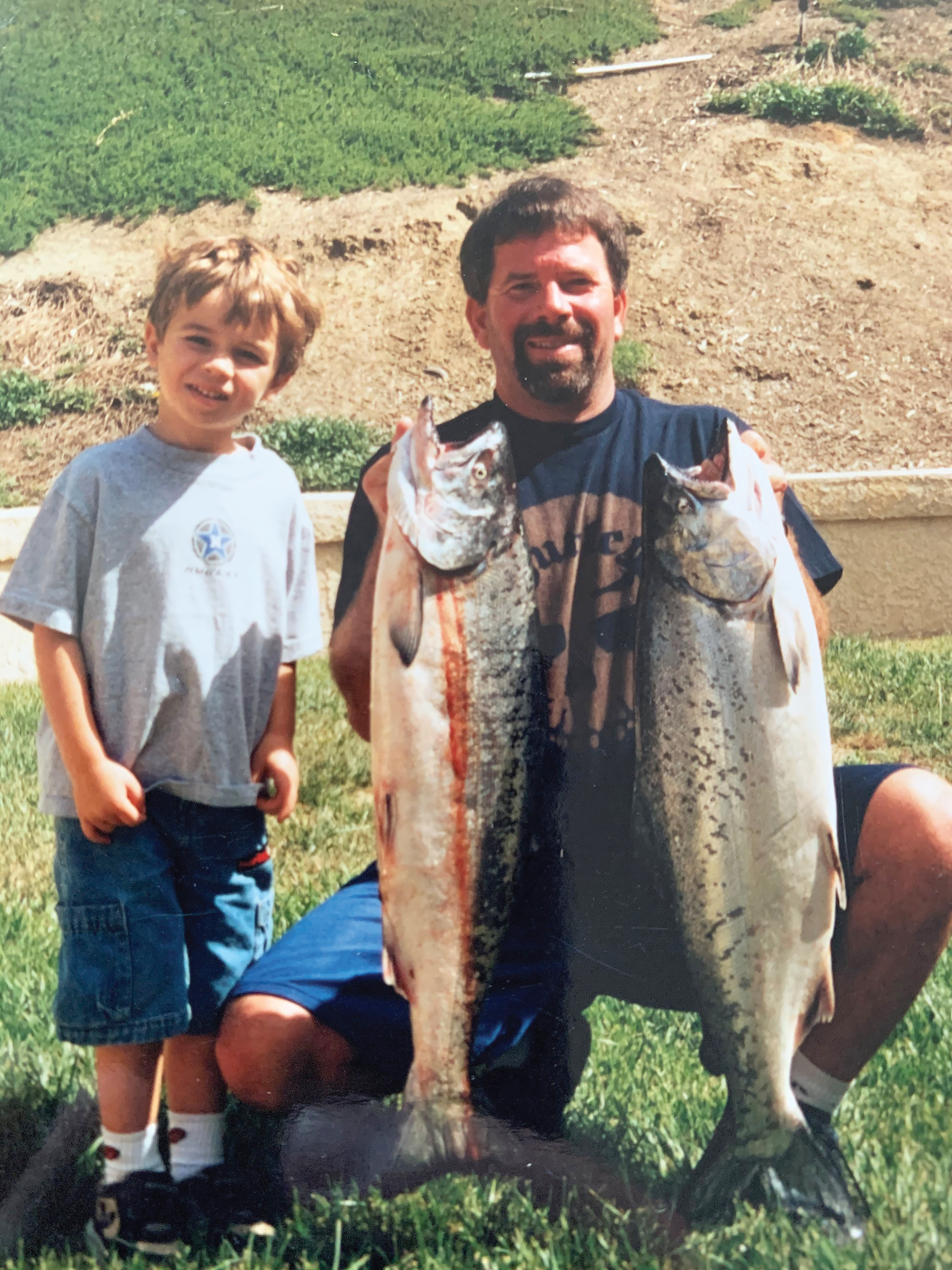 Growing up with my dad was a blessing. His love of the outdoors came from a very good upbringing from his father in Ohio and Pennsylvania. His early life was spent hunting and fishing daily not only as a first love, but to feed the family during the great depression. He loved the time spent with his mentors, and the memories he had were awesome childhood stories for me.
 The best times of my adult life now are to fish with my kids. I have made it an annual trip on my birthday that my daughters and I spend the day fishing. It’s the best birthday present ever for me and they have the time of their lives. To watch them create memories of their own that I am included in is absolutely the best.
 Food for thought:
 In 1981 a public fishing pond called Em’s Pond across Habeggers Lane from the park sadly closed to the public. Ron knew his customers would really miss the pond and since Ron and Donna had some vacant land near their resort store, Ron got permission from the California Department of Fish and Wildlife to dig and put in a pond with the thought that their customers and the public would still have a fishing pond in the same area. He took his idea to the Department of Agriculture and the Department of Fish and Wildlife with the understanding that the DFW would stock the pond.
 Currently there still is a trophy trout stocking program in Bishop Creek Canyon. It is coordinated by Jared Smith of Parchers Resort, as well as all the neighboring businesses and Resort Owners who pitch in funds. The program is assisted by Tawni Thomson of the Bishop Area Chamber of Commerce. Currently Wrights Rainbows from Idaho and Desert Springs Trout Farms from Oregon provide supplemental trophy trout stockings periodically throughout the summer and fall, so if they’re lucky, fishermen can still land a trophy trout.
 In January of 2019, Nick Scira proudly assumed ownership of Creekside RV Park. Nick has worked continuously improving the park. Wi-fi is offered throughout the park. They offer full hook-ups for RV sites up to 42 feet, tent sites, rental trailers, a country store offering fishing tackle, worms, ice, groceries, beer, wine, souvenirs, and self-serve food. The park offers restrooms and showers. Drinking water comes from the parks own artesian well, plumbed in at every campsite and it is the best! Family dogs are welcome.

 The Tomahawk is a 68-foot fishing machine that offers just over 24 feet of transom beam, making this vessel one of the better multi-day, limited load sportfishers among San Diego’s vast fleet. Not only does this sport boat fish well under most all conditions, but the spacious galley, tasty food and roomy bunks combine to make each trip a good angling experience. Add in large capacity bait tanks, a new refrigerator system in the slammer and a crew that wants passengers to catch tuna, what more could a deep-sea fisherman ask for. Last year owner Captain Eric Sauerwein invested almost $100,000 in boat work and additional upgrading of equipment to make his boat more fishable.
 The first tuna trip on board the Tomahawk was a 2.5-day trip that was co-sponsored by Izorline and it was a trip to remember. This sportfisher departs out of Fisherman’s Landing and with a limited load of just 25 anglers there would be plenty of room at the rail during a bluefin or yellowfin tuna bite. Seas were calm, as they traditionally are during the later part of July, and the hopes of Captain Jeff Spafford were that schools of bluefin would pop up in the fishing grounds offering opportunities to cast big poppers and Colt Snipers at meatballs of boiling bluefin tuna and then slide over the school to allow bait fisherman a chance at hooking a tuna.
 While most of the tuna caught that day weighed in the 25 to 50-lb class, there were a few bigger class bluefin landed along with a quality yellowfin tuna. The hot stick for the trip was held by Bobby “G” Gonzales of San Pedro who seemed always to be hooked up to a big bluefin and had no problem in landing his 2-fish limit of 100-lb tuna for the day. A number of other anglers on board also landed their daily limit of bluefin, but it was Lorenzo Robles of Montclair that topped anglers by decking a 30-lb. class yellowfin that was hooked on a kite rig.
 Spafford then went on to add, “Our off shore fishing program of offering 1 to 3.5-day fishing packages, with limited loads, has been paying off for anglers. We have the ability to move around during longer trips to the fishing grounds and when we have to make a run to a new spot, we will try to do it while passengers are asleep in their bunks. This night travel allows us to be right on the fishing grounds at day break, often a good time to kick off a great day of tuna fishing. As to what next season will offer up in the way of off shore angling, I would hope that the bluefin and yellowfin stay around. I would also like to see more kelp patty fishing for yellowtail and a return of those large schools of dorado that were around for a long time a few years ago.”


 In addition to the excellent bottom fishing the king salmon fishing was better this year than the previous year. There are two ways to fish for salmon and Big Blue Charters both trolls and mooches. I personally prefer to mooch, which is simply dropping either a cut or whole herring down to near the bottom and reel
 ing up and then repeating. I like this method as you get to feel the salmon hit. Salmon have very soft mouths unlike bass so there is some finesse needed when hooking them. The old rip a lip method will lose you a lot of fish. When the salmon hits you reel, reel, reel until it is tight then just give a slight hookset. And once the king is on be prepared for battle. They are known to come to the boat rather easily until they figure out they are hooked. At that point hold on as you are going on a ride. Just like catching a yellowtail or tuna, it is a follow your fish mentality until you get it in.
 their contribution to the vets, and it was a huge one. Dan served in the military and through conversation found out he was in boot camp with one of the wounded vets. Small world, right? Since this was early in the season the Big Blue deckhands were not available yet, so Jesse and Dan also did double work and really worked their butts off for free. But both understand freedom is not free and without these vets risking their lives for us we might not be free at all. I feel that both
  Jesse and Dan are to be commended for their efforts and honestly, I feel lucky to know such fine young men.
 While Captain Mike guided me for 3 days, Captain Jesse Graham took the vets out two days without being paid and Captain Dan Corduan did it once. That was their contribution to the vets, and it was a huge one. Dan served in the military and through conversation found out he was in boot camp with one of the wounded vets. Small world, right? Since this was early in the season the Big Blue deckhands were not available yet, so Jesse and Dan also did double work and really worked their butts off for free. But both understand freedom is not free and without these vets risking their lives for us we might not be free at all. I feel that both Jesse and Dan are to be commended for their efforts and honestly, I feel lucky to know such fine young men.

 arriving on the island around noon. With the second half of the day to burn, the option exists to take the pangas out the first afternoon for a few hours of fishing. In the several trips I personally have taken down to the island, we have never come close to having the option to fish the first day. This was indeed a welcomed change.
 and landed 4 giant yellowfin tuna on that trip. Kevin will be the first to tell you that he is not a widely experienced angler, but he always seems to have the talent or ability to get the right bites at the right time. My hats off to Kevin for his humble nature and his willingness to try new things. He again showed the fish who the boss was. He took a blue and white Killer Jig EX-7 and promptly hooked and landed a
 number of yellowtail from the high teens to the low 30’s. Not only did he make the right adjustments to this retrieve, he changed his reel as well as rod until he found a combination that he was able to make the right distance casts as well as retrieve the jig at the proper tempo to entice the fish to bite. He had a fantastic trip.


 Roy Rose quote of the day – “Whatever you do….don’t look them in the eye”.
 As we approached the Rocks, the anticipation was high as many us were ready to pull on some fish after 2 days of travel. Capt. Roy drove around the high spots and we put the anchor down and it was game on. John Collins, Matt Chang and myself prefer the long rods and it did not disappoint. The 3 of us were slinging the surface iron deep into the flat spots, watching these bruising yellows chase down the jig and eventually blowing up on it like nobody’s business. Yes, we sacrificed some jigs as they burned us off going over the ledge, but that’s part of the game.
 Bank ATM malfunction aka “Tough Fishing”.
 it was now time to focus on tuna fishing. We anchored up on the corner of the bank along with the XL and we would pluck away at these fish for the next couple of days. I’m not going to sugar coat anything, but tuna fishing was tough overall. The tax men and their gangster pack of colleagues made things worse. They were eating big baits, sardines, chunks….you name it, they were on it.
 ZZZZZZZZZZZZZZZZZZZZ. A sound I love. That is the sound of line peeling off a reel. The screaming noise at the moment was coming from a PENN spinning reel which was making that sweet sound. The PENN spinning reel I was using was part of the excellent collection of rods and reels that were on the boat while I was at Crocodile Bay in Costa Rica. All boats there are equipped with a wide array of updated PENN gear which is some of the best in the business. It always makes me feel more confident when using boat provided gear to have up to date products from a well- respected company.
 It was late March and we were trolling for sailfish with live bait when our first mate Alex decided to tie on a green hoochie on a spinning outfit in case dorado were around. The dorado might have been around but for some reason the 70-80 pound sailfish ignored the live offerings for which sailfish normally prefer and attacked the hoochie. Just like a cheetah is the fastest animal in the jungle, most claim that sailfish are the fastest swimmers in the sea. They have been reported to hit speeds up to 68 mph. So, when they have your bait and are trying to get away, they are moving.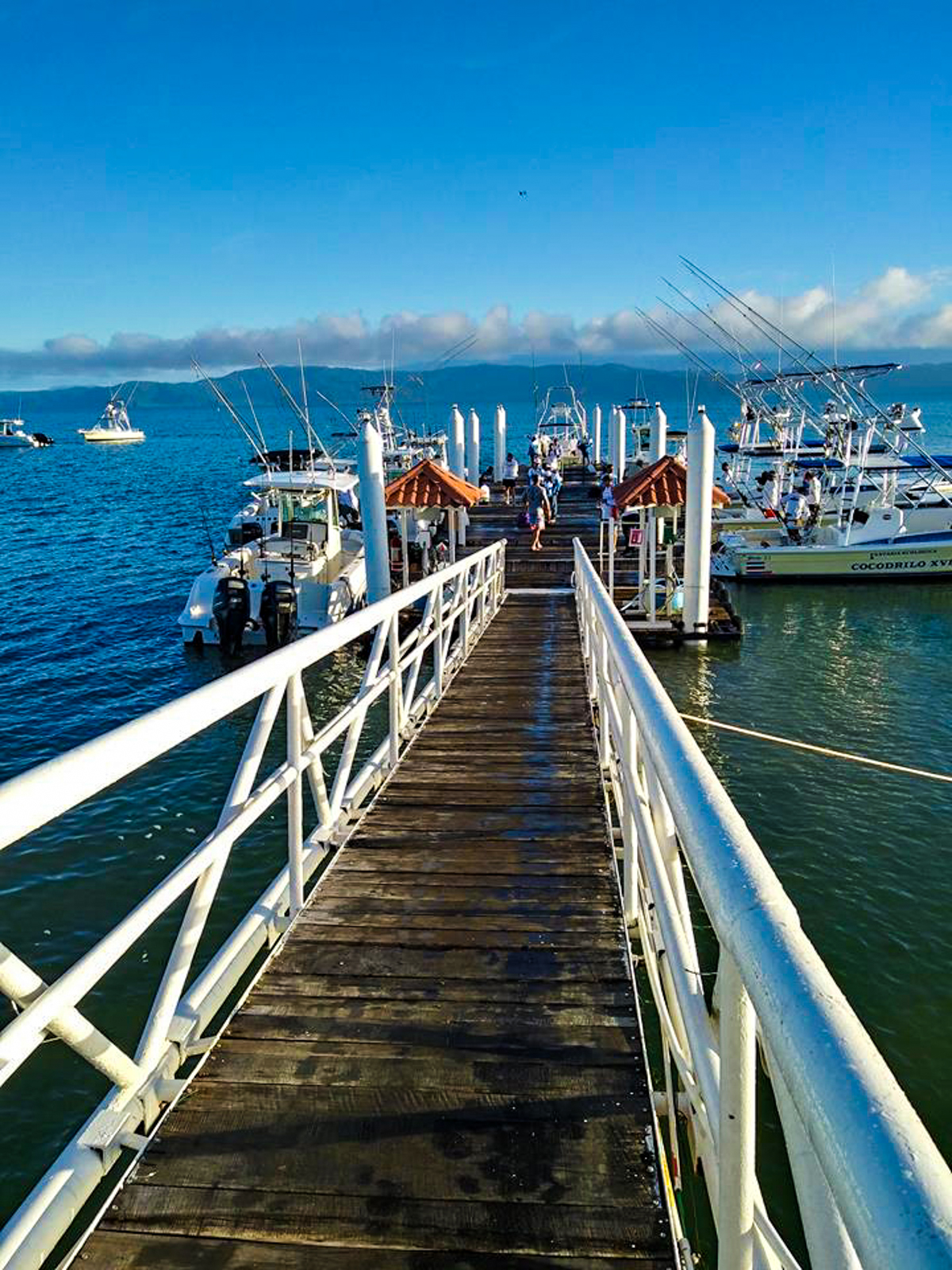


 The other pesky fish was needlefish. One of our highlights was watching two, 5-foot needlefish glide on top of the water to try and get the same bait. It looked like two missles on a collision course. We missed quite a few of these toothy fish and actually we were mad they were going through our bait.
 All the great customer service, friendly staff, great food and wide variety of things to do was just a cherry on top of the sundae. I am pretty sure this inshore trip redeemed the last time I was there and made a bad call. And in all honesty, one doesn’t need a reason to come back or go to Crocodile Bay. Just realize that after being there a few days you will be wondering why you have to leave.

 One day last year after having ran 40 miles due west in search of large bluefin that wanted to eat the yummy, we ran into a large volume of quality sized yellowfin. Just before we did though, we stumbled upon a paddy that was holding fish, and both started off the day with couple of quality yellowtail. That was not our intended fish but were happy to get them. We stayed on the yellowfin all day and picked a fish off on the popper, essentially each pod of foaming fish that we strategically stopped on. However, even with the volume of fish around, the many boats on the water would often stop right on top of the fish, sending them down much quicker then they came up. Instead of allowing these “foamers” to develop, the boat pressure placed on these fish sends them down almost instantly if the the boat is stopped right on top of them. As the majority of the boats went home, we continued to pick away. Until finally, the school of all schools came together and encircled us, creating an absolutely deafening sound, drowning out the sounds of the motor. It was chaos yet peaceful at the same time, until Jeff and I both fired out a popper, and instantly were both hooked up. These weren’t your typical school sized yellowfin either. They were 25 pounds to 60 pounds, with some that we saw down below the rest of the school that really made you wonder.