Bottom Fishing is a Solid Plan ‘B’

By Summer 2017

By Stan Kaplun

When targeting a certain fish, whether it be bluefin tuna, yellowfin tuna, dorado, white sea bass or yellowtail, “Plan A” does not always go as planned. Therefore, it’s important to always have a “Plan B”. Sometimes Mother Nature simply does not cooperate, holding you back from making the long run to your desired fishing grounds. Other times, it’s the fish that are finicky and they just don’t want to eat. In either case, a great way to salvage your day, or even enhance it in many cases, is through bottom fishing. Depending on where you are fishing along the California coast, the season usually opens as early March 1st and goes through the end of the year.
With all the species that we have in California, the options are phenomenal. Not only is there an array of different fish to target, there are so many ways to target each fish. One of the staples in our West Coast fishing world, from south of the border all the way up to Oregon is bottom fishing. From rockfish to ling cod, to everything in between, it’s a great way to get beginners and kids hooked on fishing, and it is still quite enjoyable for the avid fisherman.

The majority of the bottom fishing that I’ve personally done, has been in San Diego and south of the border. However, this last year or so, I’ve put in a good amount of time in Northern California, primarily off coast of San Francisco. Regardless of where you are on the coast, there are many crossovers in the techniques of targeting these bottom dwellers.

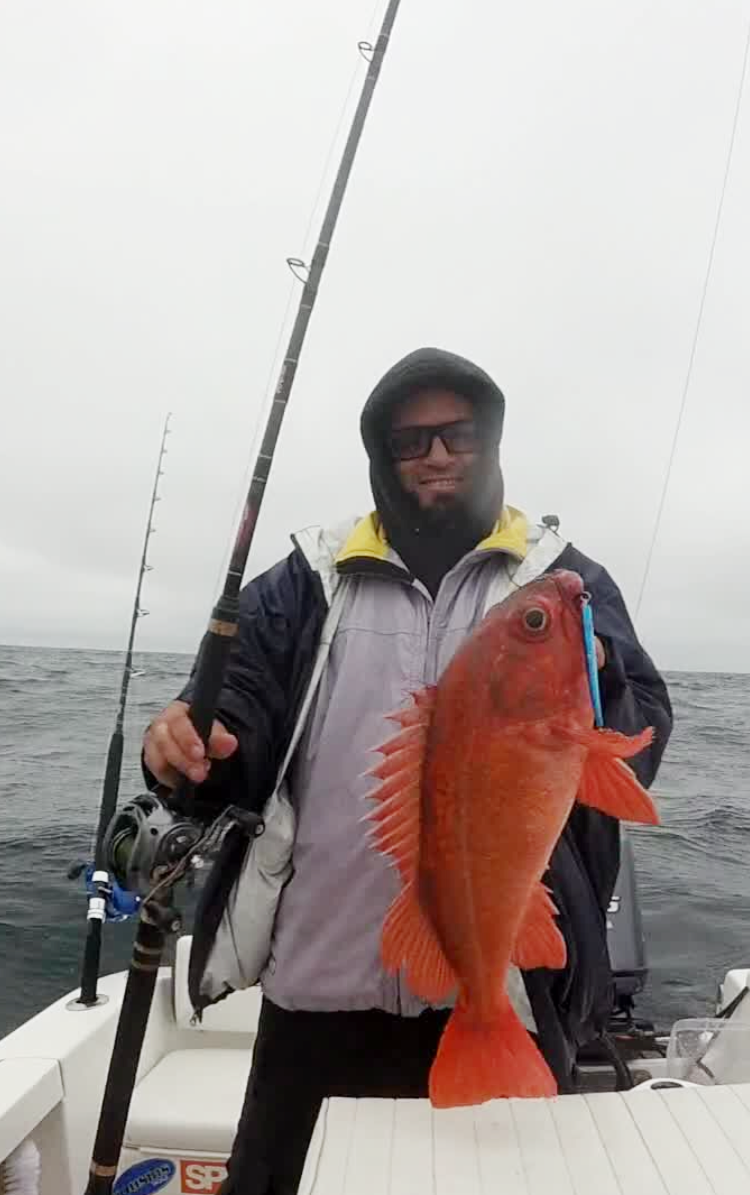
My preferred way to target the larger models is either with a heavy jig or a heavy bucktail. Depth and current will dictate how heavy of a lure you will use. When fishing at a depth of 200 feet-300 feet, a 2 ounce or 3 ounce lure just won’t cut it. In this situation, you need to go to a 10 ounce to 14 oz jig. There are numerous options out there for this but my preference is from SPRO which makes a great bait called the Prime Bucktail Jig. It comes in a variety of sizes and colors, up to 8oz. They also make a Squid Tail Jig, that is a deadly bait for shallow water bottom fishing, also offered in a handful of colors, up to 3oz. Both the Bucktail and the Squid Tail come in glow in the dark colors, which can be killer and set your apart from the next. Additionally, P-Line makes a great Chrome Jig, as seen in the photo below. It’s perfect for getting to the bottom as fast as possible, even in deep and rough seas. These range from 8oz to 16oz.

Another method, one that will typically out-fish the former in terms of quantity and numbers, is a dropper loop with two hooks. In Northern California, they will typically fish two shrimp flies, and tip them with strips of squid, whereas down south, we often fish bare hooks with strips of squid. Both methods will work in either location.

With all that said, all of the tips and advice provided above, is nearly useless information to know if the following is not done. Keeping your bait on the bottom. Many times, the is the sole difference between getting bit and not getting bit. If you “can’t keep you bait on the bottom”, chances are you are fishing too light. The solution to this is simply a heavier weight to keep your bait down on the bottom properly.

The amount of different rockfish is mind boggling, and they have equally as many nicknames. The following list includes many but not all of the most commonly caught bottom feeders; Boccaccio, Canary Rockfish, Chilipepper Rockfish, Chucklehead Rockfish, Copper Rockfish, Ling Cod, Olive Rockfish, Starry Rockfish, Sculpin, Sheepshead, and so many more. Some are better table fare then others, and some are illegal to keep. The limit per angler is 10 fish, with ling cod, sheepshead, and white fish not included in your total, as they have their own respective limit. Therefore, it’s always a good idea to have an identification chart of some sort so you have the ability to differentiate between your various catches. You can find this chart readily available on the DFW (Department of Fish & Wildlife) website.

My ideal set up for this is a shorter rod, ideally between 6’6” and 7’6”. However you can absolutely fish an 8’+ comfortably, it just all comes down to preference. The Cousins CJB 75MH is my go to rod for these applications. Its rated for 30lb-50lb line and is a medium heavy. It’s paired with a Shimano Torium 16, spooled to the top with P-Line 65lb XTCB braid. I like to use a short topshot of P-Line’s Shinsei Fluorocarbon, ranging anywhere between 30lb and 60lb.

As we get ready for what should be another phenomenal offshore and inshore season, keep in mind that not only is this type fishing great for beginners and kids, it’s also a great way to catch some prime table fare, making for delicious fish tacos.

Yucatan Adventure: A Tale of Two Peninsulas (Part One)

By Spring 2017

By Bill Waddle
I have never quite been able to get over the Collegiate Spring Break – Mexico thing. I ran the circuit in Cabo throughout my undergraduate and post-graduate years. I always fished, some years fortunate to have enough money to charter a panga, others very grateful to be on a yacht. Fast forward many years.
This Spring Break I went with my wife and kids to the other peninsula of Mexico, the Yucatan. While we Californians tend to be Bajacentric, the other side of our southern neighbor offers high adventure and a whole other ocean with different kinds of fishes.
Travel with young children has its set of challenges. Travelling five plus hours to another country ups the ante. The Uber car came mighty early and I had already dropped the dog off at the boarding kennel by 7:00 a.m. (my parents’ rescue cat has chosen our beagle as his mortal enemy!) Taking Uber was essential because we flew out of Orange County airport and returned to LAX. Almost to the airport and I realize, oh crap, I forgot my two-piece spinning rods at the house that fit perfectly bundled up at the back of an overhead compartment. Yes, I got my Phenix blanks and had the rods built with this exact application in mind. The reels and mixed tackle bag of Krocodiles, poppers and swim baits made it. Oh well.
Make the flight. Run into my buddy Tom, who is heading south to Puerto Vallarta for another ocean odyssey. We plan on comparing notes two weeks later when we are fishing on my boat, Options. We had a pretty good flight to Cancun, via Phoenix, with some sketchy turbulence over the central Mexican Highlands. My ten year old boy, Blake, is sitting next to me and asks if we were going to crash. Do I say “of course not” or give him the honest “I hope not” because we got thrown around pretty good. The remainder of the flight was fine and shortly after we cleared customs we were aboard our rented Dodge Durango heading south toward Playa del Carmen. Our destination was the Vidanta resort complex just north of Playa.
As inclined as I am to being a hard charger, after a nice dinner and a good night’s sleep, I though day one was best spent with the kids doing beach and pool time. After sleeping in a little, we get our stuff together and head to the beach. What is all of this %$#@ in the water? The white sand beaches of the Yucatan were covered in vegetative rot and the aquamarine water was brown and it smelled. Ok…pool day and a swim-up bar. Looks like I did not need the surf casters anyway!
La Semana Santa in Mexico, or any other Latin American country for that matter, is always an interesting affair. I have spent many Holy Weeks in Mexico and have a series of rituals that I follow, like tossing coins into the sea at the beginning of a maritime voyage. There are other as well…
After the seaweed day we got in out transport and headed south toward the Mayan ruins at Tulum. It was Easter, hot and extremely crowded when we arrived at the parking lot of what is a major tourist destination for Mexicans and gringos alike. I was getting major multi-generational blowback but I trudged them onward, praying that there would be a way to financially encourage our way into a more timely experience. I hired a guide and gave him a buen propina y todo se cambia. Tulum is awesome and I do not say that lightly. Major Mayan temple complexes, pyramids and other significant structures are spread along a ridge that stands prominently above the Caribbean shore. Our guide did a great job and spoke English quite well but he left after the tour was over. Tulum is magnificent but I was a little freaked out by the volume of people…asi es La Semana Santa. Thank God I rented a vehicle and did not come in a bus with all of the other people, but now I have to find it. The pathway along the ridge that edged the Caribbean had multiple ingresses and egresses. I somehow put us on a southerly route but we had the fortunate happenstance of running into a popsicle vendor with a variety of tropical flavors. As mentioned earlier, it was hot and the coconut, mango and pineapple treats were enjoyed by all of us though they were melting quickly as we walked along a coastal scrub jungle roadway. As a taxi passed by, I quickly enlisted his services realizing that a forced march would lead to stiff resistance.
Back to the car, now heading south toward the town of Tulum and the Sian Kaan Biosphere Reserve. This place is at its zenith. While we were there Rene Redzipi of Noma fame in Copenhagen is doing a pop up restaurant here to the tune of $600 per person. I would have loved nothing more than to experience what his forage centric menu would do with the existing Yucatan approach to food and the local flora and fauna but…three kids! We slipped along the tragically hip strand that along the beach. Cool looking restaurants, art galleries and boutique hotels. They don’t really have running water, sewer systems or reliable power other than generators but it is really cool. We stop for killer burgers at a place called Mateo’s. The kids play a little foosball and we have a cold beverage before heading south toward the Sian Kaan Biosphere Reserve and realize that this place definitely deserves a return visit.
The next day we are back in the car and drive north from our resort to a little town called Puerto Morelos. We talk to a guy about chartering a boat for the next day and I liked his operation so a deposit was given. Victor Reyes runs the fishing and diving operation for Marina Pelicanos and he was very helpful. We decide what the heck let’s just charter one of the pangas right now and go snorkeling.
The Palancar Reef is the second longest reef in the world and runs from the tip of the Yucatan peninsula all the way to Central America. Within half a mile from the beach it has excellent snorkeling and the seaweed was not a problem. The five of us climbed aboard our panga with the captain and divemaster. Within no time we were in the water and seeing tropical fish everywhere. Parrotfish, Sergeant Major fish and mutton snapper were among the multitude.
“Dad look there’s Dory,” was what sealed the deal, Dory is a blue tang and one of the fish characters from Disney’s Finding Nemo.
This was the first real snorkeling experience for my kids from a boat. No, we do not snorkel from Options at Catalina. I used to do it years ago but the spike in our great white population keeps us in the boat! We had a great time and dove two different sites. Even my little girl, Blaire, who just turned six gave it a try but she got frustrated because the life jacket kept riding up on her. At one point the divemaster got ahold of a ray by the wingtips and the boys got to touch it, way more wild than the Aquarium of the Pacific in Long Beach. When we got back to the pier the boat we would be fishing on the following day was tying up as well. They made quite a haul with some big amberjack, king mackeral and barracuda. The next day, April 19th, was my son Bryce’s birthday and though he gets seasick he was willing to deal with it because he loves to fish and was quite excited with the prospects when we saw the dockside bounty.
We were scheduled for an 8 a.m. departure, yeah right! Kids being kids and my wife’s insistence on adding more and more stuff to our backpacks delivered us to the dock around 8:30. We quickly got aboard and were making bait shortly thereafter. I am not exactly sure what the baitfish were but it looked like some type of scad. We caught them on these little hoochie type rigs while trolling near a commercial pier but it was slim pickings. We moved up the beach to the north and used the throw net to no avail. We had a little over half a dozen along with some dead ballyhoo and octopus. Off we went running offshore to some high spots.
While the swells were not very high, there was a fair amount of wind…Bryce got sick. Poor kid but we talked about it prior and he still wanted to go. I used to get sea sick as a kid but grew out of it. I am hoping for his sake that he does because he loves to fish and is a huge seafood fan. The kid eats raw oysters with me and any other thing found in the sea for that matter. We were having a good time on the water but I was starting to get a little nervous. We had been trolling ballyhoo in a spread covering the water column; downrigger, outrigger and one on a flat-line clip. Nothing, not even a knock down, for three hours. The captain signaled for the deck hand to crank in the gear, so I started winding in one of the trolling rids to help get us out of the area even faster. I am not one to sit around on a boat and let the mate do all the work. Besides owning a six-pack charter vessel and being an avid angler I used to be a commercial fisherman in Alaska so getting involved is what I do.
The area we moved to was on some numbers the captain had about four miles to the south and east. When he backed off the throttles I noticed that the water was not as blue as the zone we were in before but whatever, we certainly were not catching anything where we were. The first live bait went on the downrigger and before we could get the outrigger bait set we were on. I directed Bryce to the chair and we got the rod into the gimbal. He was fatigued from being sea sick but he gave it his all and was rewarded with a nice amberjack that looked to be a little better than thirty pounds.
The captain re-positioned the boat and shortly thereafter we were on again. This time Bryce started out in the chair but told me to take the rod. Cookie cutter fish was in the ice box next and I showed the deckhand how we bleed our fish and flush them out with the raw water hose before getting them on ice. He was at first a little baffled but when I explained how much better the table product was he said he would be doing it from now on.
The day ended with a little king mackeral but that fish represented one more off the species list for yours truly.
As we tied up at the end of the Marina Pelicanos pier the sky got really dark, a squall that we had been watching on the way in settled down along that stretch of the Yucatan and the sky opened up. Perfect timing because we were now settled into the Marina Pelicanos restaurant with drinks in hand. As part of your charter with this operation, they prepare your catch for lunch or dinner. I love hook it and cook it and they did not disappoint. The fish came out five ways; blackened, tempura battered, al mojo de ajo style, Veracruz style and my favorite was achiote rubbed and cooked with onions, garlic and peppers. Bryce had recovered from being sea sick and we all gorged on mariscos.
We had another pool day the next day but the day after, our last for the trip was another highlight. We were headed to Chichen Itza but stopped in Valladolid for lunch on the way. We did a little research and found a restaurant called Taverna de Los Frailes that we wanted to check out. When we got there we realized that they did not open for another 45 minutes. Fortunately, there was a very old church next to the restaurant from which it derives its’s namesake. It had just been Easter a few days prior and the church was adorned with beautiful flower arrangements and the smell of lilies perfumed the air. We were the only ones there and had a great time exploring this beautiful structure that had been originally started in the 1550s. I highly recommend a visit to the church and the adjacent restaurant that specialized in Yucatecan cuisine, a truly authentic experience.
Chichen Itza freaked me out. I thought Tulum was crowded and I am averse to crowds. Package tour bus hell is the best way it can be described. Now mind you archaeologically speaking this place is amazing and I love visiting lost cities of antiquity, but it was hot and we were ready to go as soon as we got there.
Heading back to the coast we made a detour north from Valladolid and went to a cenote just north of Tizimin called Kikil. The Yucatan Peninsula has over 2,300 cenotes, which are freshwater filled sink holes, that served both as a freshwater source for the Maya but also as ceremonial sites were sacrificial victims were tossed. The Yucatan is composed primarily of limestone and has no above ground rivers because of the porous nature of its bedrock. We had our swim trunks and after paying the family that runs this particular swim hole we were headed down the ladder to the water’s edge.
“Daddy you go first,” was my daughters request so I did. The rest of the family joined me and we were halfway across when Blake started in. “Dad are there any crocodiles in here?” was his first question. “No Blakey,” came my response. “What about snakes?” came next. “No,” was my guess. Then – “what about chupacabras? I did not respond and just as we got to the far side where the limestone outcropping created a grotto a bunch of bats that had been hanging upside down decided to leave en masse. My wife freaked and would not let go of me as we swam back to the other side with the whole family in tow.
What an adventure and I left out a lot of details. I can definitely say that we shall be returning to the Yucatan and it might even be for Spring Break 2018. Viva Mexico!

Party Boat Yellowtail

By Summer 2017

BY Shawn Arnold
With contributions from Davey’s Locker

Your reel is screaming as your line is peeling off it at a rapid pace. The fish takes a turn to the left and you must follow it. At that point, the real challenge occurs. There are nine other anglers to your left with their lines straight out. What do you do?? Well first off welcome to catching yellowtail on a party boat. Second, you head that way going over or under the other angler’s lines and rods as you chase your fish. This action has many names like the Chinese fire drill, Texas Two Step Shuffle or it sometimes is called something that I can’t print on these pages.
Most anglers who take ½, ¾ day or full day trips on our local boats are pretty good at working in unison with the person who is hooked up. It just takes a little awareness and common courtesy. And usually the captain of the boat or a deckhand will be with you every step of the way with direction on what to do. You may wonder if it is worth it, but yes catching the California yellowtail on a party boat is worth it. These fish can range from 5 to 40 pounds and not only are these members of the jack family good to eat but they are very fun to catch.
Southern California yellowtail fishing usually begins sometime in March-though this year in San Diego it was earlier and continues to November. Our local landings sportfishing trips can all catch yellowtail from ½ day trips to overnight and longer trips. Typically, the longer trips have more consistent catches and in greater numbers, but this is not always the case.
Local yellowtail fishing can be at one of our local islands which is either San Clemente Island or Catalina Island and occasionally Santa Barbara Island. Or it may be paddy hopping. It just depends on where the fish are. Either overnight or ¾ day trips are the best trip lengths to catch spring yellowtail. During warmer water years yellowtail will bite fin baits such as sardines, anchovies, and even mackerel. During normal to colder water spring periods live squid may be needed to get the yellowtail in the biting mood. Yo yoing an iron jig can also be effective as well as sight casting to breezing schools of yellowtail on the surface.
When fishing with fin baits it is very important to try and select a healthy bait and as carefully as possible hook your bait either in the nose sideways, collar area, or even belly area depending on how you want your bait to swim. Hooking the bait through the nose sideways will cause your bite to swim slightly side wards and at angle to the boat. Hooking it in the collar will also cause the bait to swim sideways as well as slightly downward. Hooking the bait in the belly will cause the bait to swim downward and away from the boat (use when wanting to have your bait go deep). If you are unsure on how you want to present your bait, hook it through the nose sideways as this will be the easiest and best for the longevity of your bait.
Once you have cast your fin bait try to let it swim as natural as possible this means letting it take line out and not pulling on it or creating resistance against the bait. If your bait is staying put and not moving much you can give it a twitch to wake it up. If that doesn’t liven your bait, then it is time to change your bait. Change your bait at least every other cast. This is very important as strong bait will get the most bites of yellowtail and almost all other game fish. The only time this doesn’t apply if you have limited bait or a limited type of bait in which case try to make the most of each bait. The deckhands will let you know if that is the situation.
When fishing live squid techniques change quite a bit. First you can use a live squid for many casts as a yellowtail will be just as likely to hit an almost dead squid as a lively one. In fact there are times when fresh dead squid is preferred to live squid. There are not too many different ways to hook a squid as you want to hook it in the upper cone area away from the head. Ideally hooking it and then bring the hook back again so it is securely attached. Lots of smaller fish will pick at your bait and if it is not securely attached it will be taken off the hook very quickly by the smaller fish. A large hook such as 2/0 -4/0 (Owner and Mustad are good brands) is ideal as yellowtail will not be hook shy like they can be with fin bait. When fishing with live squid be prepared to fish both deep and shallow or close to the surface. Sometimes the bite is right on the bottom and other times it will be in the middle of the water column or on the surface. Keeping an eye on where anglers are getting bit is the key to using the right weight for the given situation. Your live squid should not run too much even if fishing without any weight so if it starts really moving it is a fish.
Fishing iron jigs that run deep, medium weighted, and even surface iron can be very effective. One must be very careful though when doing this type of fishing. It just takes one second of not being aware to hook someone in the head. Some boats actually discourage people throwing jigs when the boat is crowded. Safety first. After making sure the coast is clear, cast your jig a good distance from the boat and then letting it sink for varying times allows you to cover different depths and with different angles of retrieves creating different presentations. The key when fishing a jig is to keep it moving. Usually the faster the better. Surface iron maybe the exception as there is times when a slower presentation works. When using an iron jig you can fish along the side and even in the front of the boat and cover a lot more area than by bait fishing. Most of your bites will come while reeling it back and you need just keep reeling as you get bit. The reeling tension and the fish should set the hook. Make sure your hooks are super sharp before you start fishing. When yellowtail are breezing on the surface a surface iron can be really effective and you can cast into the school before they are disturbed by the boat.
Finally before coming out on your fishing trip it is always a good idea to give the Landing a call and find out what bait or baits are available as determining the proper gear for your trip may depend on this knowledge. If you are renting gear then you need not worry about this as several styles of gear can be rented which should be fine for all styles of fishing for yellowtail. For live fin bait, two rods are recommended. Anglers should have 15-20 pound test and a very good reel with functioning drag. The second setup should be 25-30 pounds test on a moderate sized reel, once again with a good drag system. Much of your fishing will be done with the lighter set up for the ½ day and ¾ day trips, but when they do bite it can get very active and having the heavier setup will get more fish into the boat during this time.
The following is a list of some of the landings between San Diego and Ventura who offer sportfishing boats that you can catch yellowtail on. For more information on the landing nearest you just google them. In San Diego are there is H&M Landing, Fishermen’s Landing, Seaforth, Helgrens, and Pt Loma Sportfishing. In Orange County there is Davey’s Locker and Newport Landing in Newport Beach and Dana Wharf Sportfishing in Dana Point.
In the Long Beach area, there is Long Beach Sportfishing and Pierpoint Landing. Marina Sportfishing has closed down but some of the boats went to Pierpoint Landing. A few miles north of Long Beach is 22nd Street Landing in San Pedro. And a little further north of them are Redondo Sportfishing, Marina Del Rey Sportfishing, and much further north there is Hook’s Landing and C.I.S.C.O. in Ventura and Oxnard.

DROP in on BASS – BY Bill Schafer

By Featured, Spring 2017

https://www.fishtacochronicles.com/drop-in-on-bass-by-bill-schafer/ ‎https://www.fishtacochronicles.com/drop-in-on-bass-by-bill-schafer/ ‎ A sensitive rod like the Daiwa Tatula and running braid to the fluorocarbon leader can help you feel the subtle bite on the drop-shot rig.

The Southern California lakes are waking up and bass creel numbers are rising for all the local waters. Water temperatures are rising and male largemouth are roaming the banks by the hundreds looking for that perfect place to make a nest for themselves and that giant female mate. It is a time of year when the bass are scattered from the shallowest shoreline to the deepest point on the lake.

The author’s son Bricen shows off a nice El Capitan bass that fell for a drop shot rigged Yamamoto Kut-tail worm

So often largemouth fishermen look for that perfect bait for this time of year and that search sparks a lot of debate amongst us all. Which bait or set up is the best? Jigs, various plastics, spinnerbaits, or crankbaits, which one will draw the most bites this time of year? Well, it may be that plastics have the edge over the other baits most of the time. But, it is not so much the plastic baits themselves, but the technique used to fish them that can make a difference.

There is the Bubba rig, Carolina rig, Texas rig, split-shot set up, wacky rig, as well as a few more locally named rigs in your area. But, the rig that swept the nation’s bass fishermen off their feet and has become the go to rig over the last several decades is the drop-shot rig. This set up can be used from the shallowest shoreline to the deepest point. Sure, you can use some of the other rigs that will work this time of year, but the drop-shot rig can produce in any situation.

The drop-shot rig is most often fished on a spinning rod with a lighter action and soft tip. The line or leader is kept down in breaking strength as well, usually 4 to 8-pound test, with 6 pound being the most popular. I like to line my reel with Daiwa or Maxima braid and go with some Maxima fluorocarbon line for my leader, taking every advantage of new technology. A sensitive tip is the key to drop shot fishing. It takes some practice to detect a bite, but once you have it down it will be hard for you to put this setup away. The braid and fluorocarbon help transmit the bite as well.

The hook is tied to the main line with a palomar knot. The tag, or the end of the line not attached to the reel is left very long, so you can cut it down to size after tying the hook on. Hooks can vary with the bait being used, but usually run small. There are even specialty drop shot hooks. You will leave that tag line anywhere from 12 to 18 inches long and attach the weight to the end of it. The weights will vary with the depth being fished. There are also drop shot weights that can be changed quickly if more or less weight is needed. I still go with the old method of a large split-shot at the bottom.

So, what are the advantages to having the bait above the weight? Well, a lot of the southern California lakes have some type of moss or vegetation growing on the bottom. This rig helps you keep the bait above the bottom. Even if the fish want the bait presented right on the bottom instead of up off of it, the weightlessness of the bait lets it settle on the moss or weeds without being pulled down into it by the weight if it were right against the bait, such as with a Texas rigged worm.

Twitching this bait in almost any situation lets it dart and flutter without being hung up. Even if you hang the weight up on some bottom structure, it will just pull off and you can just quickly put another on without losing a lure or having to take a long time to retie. This set up can be fished around any type of structure there is in your local lake. Right now, the bass are on the cruise looking for nesting spots, but once they lock onto a bed this setup can be deadly as well.

Think about it. The sinker is on the bottom, below the lure. If the bass picks up the bait to take it out of the nest, she doesn’t feel the weight of the sinker as she starts off. This can give you an extra second to detect the bite and set the hook. A lot of the time the female largemouth will just suck the intruder in and blow them off the nest. But, again, this lighter object may stay in her mouth longer giving you extra time to hook her.

Sometimes the males are locked on the beds and the females are hanging off in deeper water, say out on the points leading into the spawning area. This bait still lets you fish deep as well. You may have to put a slightly larger weight on, but the effect is the same. A darting, fluttering, swimming lure looks much more natural to those big wary females.

There are companies that specialize in drop shot weights, hooks, and baits. That is how popular this method has become. Your local tackle shop will have an assortment. Usually, little smaller plastics are used, but almost any type of plastic lure can be put on your drop shot rig. Worms, creatures, grubs, or small shad type plastics, they all work with this rig.

This is the right time of year to gain confidence in a new technique. There are so many males roaming the banks that it is pretty easy to get bit. Once you gain confidence in this setup you will not put it down. It will become your go to rig and you will end up using it all season long. So, get out there and drop in on some bass!

Crappie Craze -BY Stan Kaplun

By Featured, Spring 2017


When fishing the lakes and reservoirs throughout California, from north to south, its safe to say that the most commonly targeted fish is the largemouth bass. This is true, even when many of these bodies of water hold record sized catfish that are seldom targeted, monster carp that are widely considered trash fish, and massive trout that are stocked throughout the state. As you make your way northward, the bass fishing begins to diversify and you begin to see stripers and smallies, followed by the spotted bass, the last of which just recently saw it’s world record broken yet again at Bullard’s Bar. Salmon and steelhead flood the rivers, accompanied by pre-historic looking sturgeon in the delta, the options are phenomenal and sometimes overwhelming, in the vast amount of choices. With all the above, the fish that is often forgotten is the black and white crappie.
The Crappie is a predator. They feed on prey just like bass do. Having said that, everything is relative and they can’t inhale a 10” bluegill or a 2lb trout like a largemouth can. They have been known however, to feed on the young of their predators, such as Pike and Walleye in the Mid-West and Northeast, but locally, they will gladly eat smaller bass and pan fish as well, specifically the fry of these fish. Predominantly, if there is a prevalent baitfish population in a respective lake, usually shad or minnows, that will be their main source of food. During the summer and winter months, crappie will often school in large groups and follow these schools of baitfish.
Additionally, like many other types of pan fish, crappie will also eat insects, insect larvae, plankton, and worms. This is typically the case in lakes and ponds where large baitfish populations are normally uncommon. While they follow the bait, where bait is present, many times the larger models will prefer to hang out around structure such as stick ups, brush piles, lay-downs, and ledges, positioning themselves for a quick and safe ambush attack. Depending on the time of the year and the water temperature, you can find them schooled up at different depths. When they are spawning, or moving into the shallows to spawn, they can be found in water as shallow as 1-3 feet deep. When the water is colder, typically under 45 degrees, they will hang out in water as deep as 30-50 feet deep. However, as the water gets too warm, upward of 70-75 degrees, they typically go back towards the deeper water, and will become somewhat sluggish post-spawn, to conserve their metabolic energy.
Anglers that are just getting started in targeting this fish, quickly realize that one of the largest problems is hooking crappie, followed by keeping them on the hook. They have been dubbed the infamous “paper-mouth” for a reason. They have an extremely soft and paper-thin mouth, and setting the hook too hard will often tear the membrane, followed by a quick exit of your hook from its mouth. Because you will typically be fishing an extremely light and finesse set up, you must be gentle in not only hooking the fish, but also fighting the fish, while still maintaining constant pressure. If you allow for any slack in your line during the fight, you are giving the crappie a high percentage chance of shaking the hook free and swimming off. This is why having the proper set up is extremely important in having the best chances of hooking and landing this delicious fish.
In terms of targeting these fish, there are tons of different ways to do so. Some of the more popular ways, in regards to artificial baits, range from micro jigs, grubs, spinners, small crank-baits, and small jerk-baits. On numerous occasions, while fishing for bass, the respective outing turned into a wide-open crappie bite on the bass gear. While they are primarily targeted with smaller sized bats, they will also commit to the larger baits as well. You can see that this is the case in the photo below. It shows a quality model I caught on a SPRO Aruku Shad 85, which would be considered a large lipless crank bait, with a weight and size of 1oz and 85 mm respectfully. While many, including myself, prefer to target crappie with artificial baits, they fish will gladly eat live bait, with crappie shiners being a particular favorite.
My go to bait for targeting crappie, and one of my favorite all around lures, often underestimated because of its size, are the SPRO Phat Flies, designed by Bill Siemantel. They are made in 1/16oz & 1/8oz, and come in 5 different colors, ranging from “baby bass” and “bluegill”, to several different variations of shad, as well as a bright chartreuse. They use a Gamakatsu hook and its world-class sharpness plays a large role in hooking and landing the fish. These baits are great for being able to “match the hatch” to some of the most prevalent bait fish in our California waters. The primary technique for which Bill designed these jigs, is the Float and Fly method. Because of their design and balance, they sit under the bobber horizontally, enhancing the level of presentation, but also increasing the hookup ratio. They can also be thrown like a “mini-jig”, which is typically what I do for panfish and trout. Having said that, the Float and Fly method can be quite effective for these fish as well, in addition to the trophy bass that it was designed for. With the mini jig method, it’s a short and constant twitch of the rod tip, and your tackle plays a huge factor in being able to execute it properly.
An ideal rod for these applications is one that is highly parabolic, meaning it has a slow action. It’s all about preference in terms of length, but I prefer something between 6’6” and 8”. However, longer rods will allow for a marginally farther cast, so a 9’-10’ rod can be a good fit for some as well. The rod I throw is the Cousins RSP 651. It’s a 6’6” composite blank, meaning it’s composed of both fiberglass and graphite, and it’s perfect for fishing applications such as the ones mentioned above. Paired with a 500-sized reel, the rod feels extremely light and well balanced. It’s competitive in pricing, and like all Cousins rods, made locally in Huntington Beach, CA.
In addition to rod and reel, the line size is also very important. In my opinion, the lighter the better, especially when fishing clear waters, but anything up to 6lb will work. The line diameter may affect the action of the jig, and if the fish are finicky, it will unnecessarily increase the line visibility, which can be the difference in getting bit. The line that I prefer to use is the P-Line Fluorocarbon in 2lb test. I feel more connected to the bait with the lighter line, and don’t feel it necessary to fish heavier line. Having said that, if your fishing around thick brush and stick-ups, having the 4lb or 6lb may allow for you to get the fish out if it gets hung up in structure. P-Line also just came out with a new line of Fluorocarbon called Tactical. It’s extremely strong and abrasion resistant, and comes in 6lb, which works great for the Crappie. Fluorocarbon is generally more abrasion resistant than monofilament, so even with the lighter test, you should feel confident in fishing for these panfish.
Lastly, Crappie is fantastic table fare. They’re arguably my favorite freshwater fish to eat, and are very simple to make. Once the technique is dialed, like with any fish, the filleting process is smooth and quick, and preparing them for consumption is even faster. I prefer to pan fry them using the following recipe. Take a large bowl, and empty a bottle or a can of beer into it. Add corn flour, salt, pepper, and creole seasoning. Take a separate bowl and fill it with sufficient flower. After washing the fillets, coat them thoroughly with flour, followed by the beer batter. Once you get the golden color you desire, you can drain the excess oil on a paper towel, and serve with lemon wedges and hot sauce! For those who enjoy a nice cold beer, it can accompany this meal very well.

AMERICAN ANGLER 8-DAY FALL FISHING TRIP! BY Steve Carson

By Featured, Spring 2017

American Angler jackpot winner Dr. Chong Chang, with Penn’s Jeff Ingram and trophy.
What is the ultimate fishing trip? I just might be an 8-day “variety” trip in the September-October time frame, onboard a San Diego long range boat- just like the one that A group of PENN Fishing University anglers took last October aboard the 90-foot American Angler out of Fisherman’s landing, captained by longtime veteran skipper Sam Patella.
Although “cow” yellowfin tuna are not usually on menu on these variety trips, virtually everything else that swims in Baja waters may be encountered. In fact, almost all trips see not only the major game fish species, but at least one or two individuals that need to be carefully researched in a good fish ID book!
The group was made up of anglers ranging from rank beginners to seasoned old salts. Some 10 of the 24 anglers were repeats from the previous year’s 8-day expedition. By the end of the trip, every single “wahoo rookie” had managed to land their first ‘hoo.
American Angler jackpot winners, names as noted. L-R- Dr.Chong Chang 50.2lbs wahoo, Eric McKenna 49.0lb. wahoo, Steve Osborne – 48lb. yellowtail , Tom Kvitli 48.6lb. wahoo Spring Valley, CA,

WAHOO

Wahoo are usually the glamour species on 8-day variety trips. Good catches can be made anywhere from late July to early December, but mid-October is almost always “prime time”. Wahoo were definitely foremost on Captain Patella’s mind, as he made a beeline straight for Alijos Rocks after departing San Diego.
Within two minutes of arriving at Alijos and putting the trolling jigs in the water, the first wahoo strike occurred. Avid angler Sean Chong of Portland, OR was the lucky troller, and it was his first-ever wahoo to boot. After that it was hot and heavy, with red-hot action and numerous lost fish as is normal with wahoo fishing. When the smoke cleared after the first day of fishing, 54 wahoo were in the fish hold, and all but one of the anglers had tagged at least one.
Productive wahoo lures included Tady 45 and Sumo 7X surface irons, along with KK Pono and Captain Jimmy Bombs. Live sardines were certainly a good choice, usually fished on 30-40-pound tackle, with an 18-24 inch singlestrand 40-pound wire leader and a size 2/0 Owner Gorilla hook. Some anglers tried a short length of 125-pound fluorocarbon with success, and a handful of lucky anglers managed to boat a wahoo on nothing but straight-tied 30-pound fluorocarbon.
The wahoo indeed hit on a wide variety of offerings, but the anglers learned that hooking a wahoo and landing one are two completely different things. “At one point, I lost seven wahoo in a row”, lamented the trip’s host, PENN’s Jeff Ingram. Chiming in on the topic was tackle shop owner Walt Bailey, “I was very fortunate, and landed 10 wahoo, but lost at least 40!”
A key observation was made by Ingram that is the primary mantra of wahoo fishing with lures. “I was using a reel with a 38 ‘Inches Per Turn’ rate, which is pretty fast. However, I noticed that the anglers who were using the PENN Fathom FTH40NLD2’s, which have a 42 Inches Per turn rate were getting a LOT more bites than I was. It did not seem like a huge difference in speed, but the fish obviously noticed.”

TUNA
Captain Patella made a perfect move after two days at Alijos, and steered the American Angler to the Ridge. After a bit of expert looking around and maneuvering, Patella located a bunch of school-size yellowfin tuna that were ready to bite on almost anything. The 15-40 pounders eagerly hit on live sardines, along with numerous different jigs. Several anglers participated in tossing poppers, with Williamson Jet-Poppers and Popper-Pros in almost any color drawing spectacular bites.
One more day at the Ridge saw more of the same on school-size tuna. Lurking among the tuna were a number of wahoo, with about 15 landed along with the tuna.

Walt Bailey with a beautiful wahoo.
YELLOWTAIL
Yellowtail are the bread and butter of San Diego-based trips of 8 days or less. Plenty of wahoo and tuna meant that yellowtail moved to the back burner, but they are always present to some degree on 8-day trips. “Most of the yellowtail were caught at Alijos Rocks”, related PENN’s Ingram. “Getting up and fishing a dropper loop rig at 4:00 AM worked well for the anglers who wanted to target the big yellowtail that live there. A decent number of nice yellows hit the deck, topped by a beautiful 48-pounder.”
Depending on the time of year, yellowtail may be caught almost anywhere an 8-day trip can reach, and at depths from the surface down to 350 feet. A wide variety of lures are effective, with blue/white Tady 4/0 jigs fast becoming the “default” choice for yo-yo fishing. Just about any live or even cut bait also works. The dropper loop rig is especially popular, and consists of heavy 50-80-pound tackle, a 12-16-ounce sinker, and a super strong 4/0-6/0 Owner Gorilla hook.

DORADO & MORE
With the emphasis on wahoo during this trip, only a handful of dorado were caught incidentally. During many 8-day trips, stopping on a floating kelp paddy can yield a literal bonanza of dorado, often of much larger grade than commonly seen closer to the border. When these conditions are encountered, limits of dorado in the 20-30-pound class are commonplace.
Another species that is seen in widely varying numbers is striped marlin, and about 15 stripers were released during the PENN trip. Normally a “glamour” species under other circumstances, aboard long range boats they are not a target species, and are released. If marlin are present in large schools, a boat may actually have to relocate to find a higher percentage of tuna, wahoo, etc.

Don Amboyer journeyed all the way from Michigan to catch the American Angler 8-day trip’s largest tuna, this 40.4 pounder

BONUS SPECIES
Variety is indeed the name of the game, and this trip was no exception. Some 22-different species of fish were caught, and no doubt a few more were lost before making it to the boat. This trip logged yellowfin tuna, wahoo, bluefin tuna, yellowtail, striped marlin, sailfish, amberjack, skipjack tuna, dorado, black skipjack, white bonito, California bonito, hogfish, triggerfish, sheephead, whitefish, calico bass, starry rockfish, rudderfish, hammerhead shark, and even a jack crevalle, plus a garibaldi that was carefully released.
Depending on the exact localities fished, and the vagaries of the fish gods, many additional species are commonly seen aboard fall 8-day variety trips. Commonly seen are several varieties of grouper, at least three different pargo species, common local species like barracuda and halibut, contrasted with exotic tropical visitors like rainbow runners, and of course huge number of different rockfish species, plus lingcod. Cedros Island stops may see the oversize gold spotted bass found there and almost nowhere else.
Blue marlin, sharks and black seabass may be encountered too, but the crews do their best to avoid them, and work diligently on their release when hooked. Aquatic oddities pop up all the time; including snake mackerel, louvar, oilfish, spotted scorpionfish, rose threadfin bass, and my favorite- sarcastic fringehead. Somewhat rare, but nonetheless on the “possibles” list include bigeye tuna, kawkawa, and once in a blue moon, broadbill swordfish.
School-size tuna like these were biting ferociously at the Ridge for the American Angler’s passengers.
PREPARATION
Many avid anglers may hesitate before signing on for an 8-day trip, thinking they don’t have the needed heavy tackle, or the necessary specialized skills. In reality, the skills most local anglers have, such as flylining baits to finicky fish, serve them even better aboard a long-range boat. Regarding the perception of the need for heavy tackle, the huge 50-wide size reels filled with 130-pound line used on longer trips are generally used only for trolling, and occasional kite fishing duty on 8-day trips.
Anglers aboard the trip included Walt Bailey, owner of Pacific Coast Bait & Tackle in Oceanside, who regularly helps out first-time long rangers. “Everybody comes in thinking they want a 50W and super heavy rod”, observed Bailey. “The reality is that something like a 2-speed PENN Fathom FTH40NLD2 will land almost anything you will encounter on these trips. Put on a 50-100 yard topshot of 50-pound mono, over 80-pound superbraid backing, and that becomes your go-to combo for everything from wahoo bombs, to yellowtail on yo-yo iron, to flylining live sardines for 60-100-pound tuna. To that, I add more PENN Fathom 2-speeds for different topshot tests; an FTH25NLD2 for 30-pound topshots, an FTH30LD2 with 40-pound topshots, and an FTH60LD2 with 60-pound topshots. The only time I use 80-pound is for trolling. If you can swing it, having a 9-foot jig stick with an Abu-Revo 60 is also pretty fun to play with.”
Bailey continued, “Once you board the boat, just relax, you will have plenty of time to get rigged up. Get situated, and say hello to the crew and your fellow passengers. A good mindset will make a huge difference. Don’t over pack, just think it through. Of course, don’t forget plenty of clean socks, and sun protection is huge. Go to a tackle shop that is familiar with long-range fishing to be sure you get what you need. Out on the water, the easiest piece of advice I can give is to look at the guy who is catching fish, and copy him!”
JACKPOT WINNERS
Lots of big fish were caught, and the official winners were: Overall Jackpot winner was Chong Chang with a 50.2-pound wahoo [he also had a 60.2 pounder caught trolling]. Chang took home a PENN Fathom 2-speed reel. Second and third place in the jackpot were Eric McKenna and Tom Kitli, with 49.0 and 48.6-pound wahoo. Largest yellowtail was a beautiful 48.4 pounder, which earned angler Steve Osborne a new PENN U.S. Senator US113N reel. Heaviest tuna was a 40.4-pound yellowfin, caught by Don Amboyer, and the “Hero Fish” was the amberjack caught by Eric McKenna, and Joe Bailey had the “Most Unusual” with a 15-pound jack crevalle.

Bluefin Tuna Fishing on the O95 By: Kyle Farmer

By Featured, Spring 2017

I got back from a 1.5 day aboard the O95 on the Wednesday before Thanksgiving and the trip was nothing short of epic. My two friends, Coleman and Andy, joined me for this trip. Let me start out with saying that Capt. Rick and the crew of the O95 are top notch and will do their absolute best to put you on fish and stay till late to get bit.
We started out the trip with the captain telling us it’s been a grey light and late night bite with a slow pick during the day and everything went exactly as the captain ordered. Weather was a little nasty the night before and we had to pace ourselves out to the Tanner. The boat didn’t start fishing until about an hour after first light, so we missed the grey light bite. That was kind of a bummer but there was nothing anyone could do about it.
We got on the first school at around 7 am and about four people hooked up within 20 minutes. A few fish were landed up to 100 lbs. One was a Shimano flatfall fish and the others were on 1.5 oz. glow in the dark sliding sinkers. For the next 8- hours we did the exact same thing, except fishing was even slower and only picked about one fish per drift for the boat. The fish were on the meter they just weren’t willing to eat a bait for some reason. All day our group had been pumped up for the night bite and hoped it lived up to our expectations so we weren’t too worried when the whole boat only landed 5 in the daytime fishing from 7am to 5 pm.
About an hour after sun set I hooked my first fish of the day. The captain said he was metering fish down at the bottom at 240 feet, so I put on an 8-oz. sinker rubber band rig and dropped straight for the bottom. Winds and swell were up so it was crucial to have enough weight get to the bottom quick. I hooked up about 10 seconds after reaching the bottom, 1 crank up. While I was fighting my fish the rest of the boat asked how I hooked up and soon enough they all had heavy weights on. About three more guys hooked up on fish, all of which were lost. I got mine to the boat after an hour of pain with my single speed Shimano Torium. The Bluefin taped out at 104 lbs. The Captain said we were going to start another drift but if it doesn’t shape up we are going to head home. By this time, it was already about 8 pm.
On the way back up the bank, Capt. Rick said the meter was starting to stack up with fish like the other recent wide open night bites from 180 ft. to 240 ft. He said he was metering solid Bluefin. The boat pulled up to our next drift and sure enough it went semi-wide open with about half the boat bent. If you could get a bait anywhere within 50 feet of the bottom, you were bit. It was also a bite every drop on the glow in the dark flatfall. We could see squid rising up to our boat so we must have been right over a squid bed. You didn’t need to have glow in the dark sinkers to get bit at night time, anything that got you deep worked. We repeated this for 3 more drifts and our boat ended the night with 34 Bluefin to 112 pounds. The Captain kept us out there until 1 am battling those big Bluefin, and I’m not complaining. And neither was anyone else. Most of the fish were around 70-90 lbs each. I would guess that everyone on the boat had a chance to get a fish because by the end of the night a lot of people were offering to hook and hand. I also heard the Fortune got a few fish up to 300 pounds. I ended up going one for four on the bluefin. Those with the right gear could have had at least 3+ fish each. The trip ended up being a trip of a lifetime and my friends and I all went home stoked as ever. I ended up feeding my family Bluefin for Thanksgiving dinner. That was quite a treat for everyone. Thanks to the crew of the Oceanside 95, truly one of the best operations out there. Thanks to Daryl Duong for taking photos.

Remembering My Dad Bud Einstoss

By Spring 2016

By Fish Story Lori

Bud and Harriet Einstoss with a huge tuna that Bud caught on a long range trip.

Bud and Harriet Einstoss with a huge tuna that Bud caught on a long range trip.

Fishing is in my blood. My whole life I grew up eating sport caught fish, with fish mounts on the walls and fishing magazines on the coffee table. Fish Taco Chronicles was my Dad’s favorite magazine.

My Dad was born and grew up in Los Angeles, Ca. and had spent 8 years in the Navy, 4 years active and 4 years reserve. My Dad knew all the local boats and good places to fish off shore.

I had no idea back then that the sport that my Dad loved so much was so expensive and required so much time and work, equipment, rods, reels, line, hooks, jigs and so much more. Dad especially loved to have custom rods made and wrapped just for himself and Mom. I always dreamed of having one of my own.

As I grew up, I met and married the love of my life Tim. I wanted to fish on the ocean like my Dad, However, I discovered a different kind of passion, a passion for stream and lake fishing. It was a passion that Tim had grown up with. Dad had never fished the mountains, in lakes or streams. Tim and I have been ocean fishing many times. For now we keep going back to the Eastern Sierra.

Dad was incredibly passionate for the sport of fishing. He and Mom Harriet were always planning long range trips on sport fishing boats. The Royal Polaris was their favorite. To this day Frank LoPreste remains the owner and captain.

In March 1983, Dad took the Royal Polaris’s first ever, 3 week trip, to the Clipperton Islands. The Royal Polaris was the first ever sport fishing vessel to go there and to date has been back 15 times since. The Royal Polaris had 27 passengers and 9 crew members on board for this excursion. Dad spent months getting ready. That trip was epic and the highlight of his life. The fishing was phenomenal catching enormous tuna over 300 pounds, blue marlin up to 300 pounds and black marlin up to 600 pounds. Dad caught a world record yellow fin tuna. It weighed in at 322 lbs. He won the jackpot for that fish!

This is the picture of the Passengers and Crew from the Royal Polaris Trip to Clipperton Islands - March 10, 1983 Passengers: Brian Adamson, Clint & Linda Bower, Dave Buchanan, Gordon Cleveland,Jim Corey, Bill Craig, Ed & Susan DeLong, Dick & Marvel Dulmage, Bill Hagen, Carl Hansen, Jim Holland, Bud Einstoss, Howard Folsom, George Jennings, Ralph Mikkelsen, Chet Mondor, Gene Morford, Paul Murphy, Whitey Patterson, Kenneth Pepping, Wayne Prescott, Mike Richards, Ron Rock, Milt Shedd, Lee Stockland, Jim Stout, Mike Woods. Crew:Dean Adams, Steve Cassarino, Jim Heyns, Gene Hill, David Kagawa, Stephen Loomis, Frank LoPreste, J.R. Massa, Tommy Rothery.

This is the picture of the Passengers and Crew from the Royal Polaris Trip to Clipperton Islands – March 10, 1983
Passengers: Brian Adamson, Clint & Linda Bower, Dave Buchanan, Gordon Cleveland,Jim Corey, Bill Craig, Ed & Susan DeLong, Dick & Marvel Dulmage, Bill Hagen, Carl Hansen, Jim Holland, Bud Einstoss, Howard Folsom, George Jennings, Ralph Mikkelsen, Chet Mondor, Gene Morford, Paul Murphy, Whitey Patterson, Kenneth Pepping, Wayne Prescott, Mike Richards, Ron Rock, Milt Shedd, Lee Stockland, Jim Stout, Mike Woods.
Crew:Dean Adams, Steve Cassarino, Jim Heyns, Gene Hill, David Kagawa, Stephen Loomis, Frank LoPreste, J.R. Massa, Tommy Rothery.

Bud Einstoss with another successful catch of tuna.

Bud Einstoss with another successful catch of tuna.

At that time it was a world record! He also caught the 2nd biggest fish as well, weighing in at well over 200 pounds. His fishing was so prolific he had to call Tim and I from Cabo San Lucas to rent an enclosed 1-ton U-Haul truck to transport his haul home. We met him at the docks at Fisherman’s Landing in San Diego, Ca. We were there when the boat arrived. After 3 weeks, we didn’t recognize him. He was so tan, and he had grown a beard. Dad said he had an amazing trip. After the trip, Dad packed our freezer and fridge full of fish. We had so much fish that it took us months to empty the freezer! On top of that, Tim and I were invited as guests by my parents to the 100 lb. club award dinner at the home of Frank LoPreste in San Diego so that we could meet Dad’s fishing buddies and the crew from his trip.

In 1997, my Dad took another “Epic” trip of a life time. Dad and Mom went on another long range trip on the Excel this time. Pat Cavanaugh was the captain. The Excel was near the cross, south of San Diego and the Baja Peninsula. My Dad scored a Pure Grand Slam for the Eastern Pacific there. He took all five species of tuna, (albacore, big eye, bluefin, skipjack, and yellowfin)! topped off with a dorado. This hadn’t been done for over 10 years! I just recently spoke with Bill Roecker, a well known writer and columnist, who was on that epic adventure. He said to his knowledge the Pure Grand Slam has not been done since Dad’s. Bill made a DVD on this trip. It’s called The “Grand Slam” by Bill Roecker.

The author with her father who gave her the gift of loving to fish.

The author with her father who gave her the gift of loving to fish.

Dad and Mom seemed to always have so much fish. They had fish in the freezer. They had smoked fish in the fridge. They even canned their own tuna. They sported their own label. “Caught and canned by the Einstoss’s” There was never a shortage of fish. Dad always made the most delicious cioppino with huge chunks of different species of tuna. My Dad loved to smoke his fish after a long range trip. Often he would smoke part of his catch hardest time in my life. I wanted to share with you how amazing it was growing up with a man who truly loved the sport of fishing. My Dad loved to fish and provide good food for his wife and 4 kids.

After my Dad retired it was never like that again. Due to health issues the fishing became too hard for him. My older brother Mike goes long range fishing now. He supplies our family with all the fresh caught fish, so that Dad never had to stop eating the fish he loved. Reading the fishing magazines and seeing our pictures in them brought him great joy. Dad would even joke around telling me his bait was bigger than the trout I had caught.

I hope some day to catch that big tuna and feel what Dad felt back in the day.
Tight lines forever,
Fish Story Lori

Fish Story Lori
Lori Carnahan
P.O. Box 981
Rancho Mirage, Ca 92270
(760) 218-9489
fsl@fishstorylori.com

Royal Polaris
2838 Garrison street
San Diego, Ca 92106
Captain Frank LoPreste
(619) 226-8030 – Fisherman’s Landing
www.royalpolaris.com

Bill Roecker
Oceanic Productions
P.O. Box 6033
Oceanside, Ca 92052
(760) 941-2029
Bill made a DVD of dad’s grand slam. It’s called “Grand Slam” by: Bill Roecker – Oceanic Productions 1998. You can order it at bill@fishingvideos.com

Exel Sportfishing
2838 Garrison street
San Diego, Ca 92106

Captains: Justin Fleck, Mike Ramirez
(619) 223-7493 – Fisherman’s Landing
www.excelsportfishing.com

Will There Be HOT Fishing at the COLD Trout Opener?

By Spring 2016

by Shawn Arnold

Last year anglers were fishing on dirt at Crowley Lake but I am pretty sure they will be in snow this year - Photo Mike Stevens

Last year anglers were fishing on dirt at Crowley Lake but I am pretty sure they will be in snow this year – Photo Mike Stevens

The Eastern Sierra trout season starts the last Saturday in April (this year it’s April 30) and ends November 15 in Mono County and parts of Inyo County. A lot of people who fish the opener call Opening Day Fishmas. This weekend is like a holiday to them. That is how much they look forward to it. Some one once said to me about the opener, this is where kids go and hope they can be adults and adults go so they can get away and be a kid. I have been fishing the opener since 1977 and we have a group of 30 or so who come back each year. We lose a few and add a few but us die-hards (or nuts?) are always there. There are plenty of other groups just like us of 10, 20, even 30 people who make the trek each year.

As always I have no idea what to expect up there weather wise this year. The eastern sierra version of Mother Nature has a nasty curveball and throws it every year at the eastern sierra opener. If you think it is going to nice, it snows. If you think it is going to snow it is warm. I have seen it snow and be freezing on the opener and be 60 degrees on the next day. As of this magazine going to print I assume that with El Nino coming that a lot of lakes will be iced over and perhaps there will be ice fishing. But with the eastern sierras you just never know. Just come prepared for anything.

The author bundled up fishing as it snowed last year on the opener. The good fishing made the cold not so bad.

The author bundled up fishing as it snowed last year on the opener. The good fishing made the cold not so bad.

Lone Pine to Big Pine

When driving from southern California the first fishable area you will arrive at from Highway 395 is the town of Lone Pine. This is about 240 miles or so from Orange County. The last spot is Bridgeport, which is about 420 miles from Orange County. I would recommend you fill your tank with gas in southern California as the prices are better in southern California than in the eastern sierra. And as you are driving up there I recommend you fill up again at the Fort Independence Casino just past Independence. Their prices are usually 10 cents a gallon cheaper than any where else you will see in this region.

The Owens River in Lone Pine is more of a bass spot and the trout fishing really starts in Independence which can be excellent for bass in addition to trout. Try a night crawler in the Owens in the Independence area and you could end up with a bass or trout.

Diaz Lake is an 80 acre lake 3 miles south of Lone Pine that offers up trout, bluegill, catfish and bass in a rather sterile environment. I can say the restrooms have been clean every time I have stopped there and they have some nice picnic benches so it is worth a stop to take care of business if needed and relax there and throw out a line.
When you go up to the eastern sierra, if you have not done so in a while change the line on your reel. While I use two-pound test, you should have no more than 4 pound on your reel unless you are trolling. The fish can be quite line shy in the crystal- clear waters of the sierra. When using light line just make sure to tie a strong knot and take your time bringing in a big fish. If you catch a nice fish let it tire it self out. And if you catch a nice fish make sure to retie your knot afterwards.

In Big Pine there are some nice spots on the Owens River. What to use and how to use it depends on water flow and other variables. Just stop in a local tackle shop and get their advice. If you are looking for a nice place to have breakfast, lunch or dinner in Big Pine I highly recommend the Country Kitchen. It has a big yellow sign and is right on 395. It is run by Andre Nersesian and his brother. Andre is from southern California and is a well known trout fishermen.

Bishop Area

In the city of Bishop there are numerous good fishing spots. The Owens River is open year round for fishing as is Pleasant Valley Reservoir. And this year the Bishop Chamber of Commerce is buying some BIG fish to be planted before the Blake Jones tournament in February and March. All those fish will not be caught that weekend so there should be some 5 pound plus hold-overs into the summer. Not all bodies of water are open though. Make sure that it is legal to be fishing where you are fishing before you toss out a line. The state of California needs money and what better way to get it than giving a ticket to some guy fishing in the wrong area. Check with any of the tackle shops in town for what bodies of water are OK to fish. The local tackle shops are full of information, as they want you to catch fish so you will come back and keep their economy going. Reagan’s Sporting Goods on the main drag usually has a free bbq while supplies last on the Friday before the opener.

This year Western Outdoor News is putting on a fishing derby from Lone Pine to Bridgeport with Bishop being the main weigh station. The winner will win an aluminum boat according to the Bishop Visitors Bureau. Contact the Bishop Visitors Bureau for more information about the derby. There is a $20 entry fee to be eligible to win the boat and all of the other prizes in the contest.

When fishing the Owens I usually use mini-jigs in the cricket color and they usually work well. Also a Rooster Tail in the ¼ ounce size usually will get you some fish. I like to walk from spot to spot and am in constant movement. If I don’t get something in about 20 casts, it is on to the next spot. There is a lot of brush so you might have to walk 50 yards through some brush to the next spot. Some areas become a dead end so you might have to get back in your car and look for another opening along the dirt roads that take you through the valley. Just be careful on some of those roads. Common sense should dictate.

This past October I fished off Warm Springs Road with a nightcrawler and a #10 hook and a splitshot. I cast upstream and let it drift down and caught 10 small browns in an hour. Luckily they were all lip hooked and released to live and fight another day.

The lower Owens from Pleasant Valley Reservoir down stream to Five Bridges Road is a wild trout river. Check with a tackle shop like Reagan’s in Bishop for constantly changing regulations. Like I said earlier, you want to make sure you are fishing in the right place or you may end up with a ticket. The state does not do the best job of letting you know if you are fishing in a legal spot or not.

Fifteen miles above Bishop, at around 8500 feet elevation, the trout filled waters of Bishop Creek, Sabrina Lake, North Lake and South Lake all offer excellent possibilities. You can easily get to this region by making a turn in the middle of Bishop on West Line Street, which is also known as the 168. It used to be on opening weekend this region was usually snowed in. Last year it was not and was not advisable to ice fish. This year with El Nino my guess is that you will be able to but better safe than sorry. As this goes to print there is no way to know if that region will be safe for ice fishing. Your best bet is to call Jared Smith at Parcher’s Resort or the Bishop Visitor Bureau and ask them.
Intake 2 is always jam packed on opening day. There are usually some nice fish taken there on the opener.

During the summer and fall the Bishop Creek Canyon is a magnificent area to be in. The fall is really nice up there as the leaves start to change color and turn brilliant colors of orange and yellow. The fishing is usually very good. There are some nice backcountry lakes to hike to and fish at but be warned that you will be hiking at around 10,000 feet and you should give yourself a day or two to get acclimated to the elevation. For more information about backcountry hikes see Jared Smith at Parcher’s Resort booth at the Fred Hall show in Long Beach or Del Mar or read his book Fishin Trails or the soon to come out Fishin Trails 2.

Once you are in the Bishop Creek Canyon lodging options include Parcher’s Resort, Bishop Creek Lodge and Cardinal Village. All provide clean lodging and are very close to the excellent fishing up there. They are all 15 to 18 miles away from downtown Bishop and offer a nice change from the city down the mountain.

Bishop has numerous nice motels and most of them are geared for fishermen. My favorite is the Best Western Creekside Inn. The Creekside Inn has a real nice breakfast buffet and even though they are a bit pricier than most Bishop Hotels, those of you who like an upper end hotel will feel you got your moneys worth. The other Best Western is a good one too. Also the Holiday Inn is a nice place.

Restaurants are plentiful in Bishop. The real hidden gem if you like good food is the bowling alley. Great steaks and seafood (can you believe it?), very reasonable prices, full bar and the owners Tom and Jackie are just real good people. This is where the locals go. The ambiance is pretty casual but the food is good. For more info on the Bishop area call the Chamber of Commerce/Visitors Bureau at 888/ 395-3952.

As you work your way up route 395 from Bishop towards Bridgeport, lots of fishing spots await. About 15 miles past Bishop is Tom’s Place. Rock Creek Lake can have good fishing, but is usually iced over until the end of May. My guess is that will be the case this year.

JohnJay Crawford caught this 5lb 1oz brown out of June Lake on opening morning last year. He caught it on a Sierra Slammers swimbait. It won “Biggest Brown” in the June Lake Monster Trout opening day derby. 

JohnJay Crawford caught this 5lb 1oz brown out of June Lake on opening morning last year. He caught it on a Sierra Slammers swimbait. It won “Biggest Brown” in the June Lake Monster Trout opening day derby.

Mammoth Lakes Area

Right before the City of Mammoth still traveling north on 395 is Hot Creek. It gets its name from the hot springs naturally heated waters. Fishing Hot Creek is strictly catch and release, barbless artificial. I am told that this is a world-class fly fishing destination. There is a lot of moss and weeds in the water so it is really not too easy if you are not fly-fishing.

About 23 miles past Bishop with a gradual climb up is Crowley Lake. Crowley is perhaps California’s most famous fishing lake. Its reputation is well deserved. If you fish there on the opener expect it to be cold. In fact if you fish anywhere in the sierra on the opener, expect it to be cold.

Dress in layers and make sure you have gloves and some warm socks. I always bring some hand and feet warmers too. I would much rather have the insurance of too much clothes and some warmers than to freeze my butt off. You can always take off clothes if you get warm. I am always amazed of anglers who make the 6-hour long drive on opening day and are not prepared. Let me warn you now. The chances of it being cold are better than it being warm. Bring warm clothes. I have been doing this since 1977. Last year it was 60 in June Lake a week before the opener. It was about 20 degrees on the opener. You can’t trust the weather up there. Just come prepared.

Crowley can be very crowded on opening day. In the old days they said you could walk across Crowley from boat to boat it was so crowded. Now days it has not been that crowded. Limits are usually the rule at Crowley on Opening day and through out the year. They have a big float-tube tournament in the fall and in the summer the Sacramento perch bite can be wide-open.

The lake has a marina with boat rentals, launching facilities and bait and tackle shops. For the latest information about Lake Crowley call the marina at 760/935-4301. Or check out their website at www.crowleylakefishcamp.com. The lake is 650 surface acres (on average).

A short drive past Crowley Lake is Convict Lake. It is located right off Highway 395 across from the Mammoth Airport and just minutes from the town of Mammoth. Convict Lake is a real eye catching gem. Don’t let its beauty fool you though. There is excellent fishing in this 168-acre lake. At just under a mile long and a half-mile wide, numerous spots can be fished from shore. This year they plan on pre-stocking the lake with some 3-5 pound fish and I was told that they have lots of hold over 4 plus pound trout from a stocking late last year. There will also be 23 tagged fish that combined will provide $1500 in cash and prizes and one lucky angler will win up to $500.
The resort has a renowned gourmet restaurant, deluxe cabins and houses for rent and a well stocked general store. More information can be found at www.convictlake.com.

The Mammoth Lakes area is only about seven miles past Convict Lake. There is NO lake called Mammoth Lake, it is just the name of the city. Even though it does provide some of the best skiing in the United States it is growing in popularity for its fishing. There are five lakes accessible by car in the Mammoth Lake area. The most popular is Twin Lakes, which are really three small lakes, joined together by a stream. Lake Mary, Horseshoe, George and Mamie are the other lakes.

All lakes can provide very good fishing but usually are frozen over until early-June. At press time it looked like they might be partially open to all the way open for the opener. Good for now but not for the long run. This area offers a wide array of lodging facilities. Hotels, motels, and condos are available. Numerous restaurants from fast food to gourmet add to the convenience. For lodging options check out www.mammothinfo.com. Mammoth a nice place to be in the summer too. Lots of fishing and hiking and there are enough nice restaurants and shopping to even keep the non fishing wives happy for 3 or 4 days. For more information about the mammoth area and things to do in all 4 seasons visit www.mammothinfo.com

June Lake Loop

About 18 miles past Mammoth lakes is the June Lake Loop my favorite eastern sierra destination. The June Lake loop consists of four lakes. You must get off 395 and onto highway 158. A short two-mile drive delivers you to the town of June Lake.

The four lakes are June, Gull, Silver and Grant Lake. The only city in the loop is June Lake. It offers 9 or 10 motels and 7 to 8 restaurants depending on the year. Fishing tackle and insider tips are available at Ernie’s Tackle. Ernie’s is well known, and is open most the night before opening day. They also put on the Monster Trout derby for the loop lakes on opening day. If you plan on visiting the June Lake loop contact Ernie’s at 760/648-7756.

The first building you see when you come into town is the Boulder Lodge, which overlooks the 320-acre June Lake. It is a popular lodge. For years I stayed at June Lake Pines Cottages on opening weekend. It is certainly not the Ritz but was OK for a couple of guys who want to fish and sleep. Problem is they got new owners who changed policy and gave my room away for the opener. And they were not very apologetic about it either. Well sometimes those things that you think are bad are a blessing as I rented a condo over looking June Lake for just a little more money. Much nicer with more amenities. I highly recommend to anyone looking to stay in June Lake to look for a condo. There are two marinas on June Lake to rent boats. Trolling is a very popular method on this lake. Shore fishing is available off route 158 (a real steep climb) and near the beach area.

Gull Lake is a short walk from June Lake. This is my location for fishing on opening day. I switched from Crowley over 30 years ago. This small lake offers up some big fish on a regular basis. Rainbow, brown and brook trout are available. If a boat is available it is better to rent a boat here, as a large percentage of shore space is inaccessible. My favorite spots include brookie hole, in front of the playground (which also offers good shore fishing) and the reeds. Both bait and lures work well. Over the years I have done best here with Thomas Buoyant, mini-jigs like Sierra Slammers,Trout Trap Stingers, Lip Ripperz, B-Line jigs and night crawlers. As the water warms in the summer you can catch Sacramento perch in it.

If you ever stay in June Lake be sure to eat at the Sierra Inn. The night before opening day they put on an excellent buffet and usually have live music. In the old days a big group of us would close the place down and go to bed at 2 A.M. just in time to wake up at 4 A.M. for the opener. Now that I am a little older and wiser my head hits the pillow by 10 PM.

Silver Lake is about two miles past Gull Lake. This scenic lake offers good shore fishing. There is a nice little restaurant there for breakfast and lunch. Rush Creek flows into Silver Lake from both sides. Rush Creek is always jammed with anglers fishing the many pools on it. Seems like each year there is always a big fish caught from this creek.

Shane Hansen caught this nice stringer using B.line mini-jigs out of June Lake last year.

Shane Hansen caught this nice stringer using B.line mini-jigs out of June Lake last year.

The creek then flows into Grant Lake, which is the least scenic of the four lakes in the region. However it provides the best opportunity for large brown trout. Inflated night crawlers or Fire Tiger Rapalas seem to catch a big brown every year here. Grant Lake is three times bigger than June, Gull, and Silver combined. While driving keep on route 158 and it runs into 395 again. Route 395 then goes to Lee Vining then twenty-five miles later to Bridgeport where there are numerous angling possibilities. The big body of water you see from Lee Vining is Mono Lake…sorry to say no fish in that lake.

Bridgeport Area

The largest brown trout ever landed in California was landed in Bridgeport’s upper Twin Lake. The monster weighed in at over 26 pounds. Large browns are caught ever year in Twin Lakes and Bridgeport Reservoir. Walker River produces some nice fish also. Usually the conditions are a little harsh in Bridgeport on opening weekend but the big browns seem to love it. Locals say the nastier the weather, the better your chance of catching a big brown.
Bridgeport has a few restaurants and motels along its main drag on Highway 395. Driving up Highway 395 and fishing its many spots makes for some great fun from late April to mid November. If you have not made the trip to the eastern sierra make plans now. In the summer this region makes for a great family vacation.

AMERICAN ANGLER TAKES PENN FISHING UNIVERSITY ANGLERS TO WAHOO SCHOOL

By Spring 2016

By Steve Carson

American Angler crewman Andrew Viola [L] lends a gaffing assist for Walt Bailey, owner of Pacific Coast Bait and Tackle in Oceanside. Bailey landed the beautiful wahoo with a PENN Fathom 2-speed reel. 

American Angler crewman Andrew Viola [L] lends a gaffing assist for Walt Bailey, owner of Pacific Coast Bait and Tackle in Oceanside. Bailey landed the beautiful wahoo with a PENN Fathom 2-speed reel.

The 24 anglers aboard Captain Sam Patella’s “American Angler” out of Point Loma Sportfishing in San Diego knew that a strong El Nino was placing the fish in some less than usual locations. Anglers from SoCal, NorCal, Oregon, Washington, Florida, and even Hawaii journeyed to San Diego for what was to be a very interesting PENN Fishing University adventure.

WAHOO!!

As the American Angler headed south toward Alijos Rocks, Captain Patella investigated several areas that had been holding wahoo on previous trips. The first day after departure, the boat could coax up only a single wahoo from the vicinity of the Ranger Bank and San Benitos Islands. Continuing south to where the previous trip had scored well at Hippolito and the Richardson Bank, our group could only manage two of the wily skinnies, all on trolled marauders.
Upon arrival at Alijos Rocks on day 3, the crew immediately deployed the standard-issue wahoo trolling rigs; large marauders in orange/black, purple/black, and dorado colors. Besides rigging the trolling lures in the traditional manner on 275-pound wire cable, some of the marauders were rigged on 300-pound fluorocarbon. Despite plenty of effort, including trying a rainbow of lure colors, along with several different spread patterns and speeds, not a single wahoo was caught trolling during two full days at Alijos.

Both American Angler crewman Dave Ibrahim, and angler Karen Schantz are very happy about this nice wahoo caught during the PENN Fishing University 8-day trip.

Both American Angler crewman Dave Ibrahim, and angler Karen Schantz are very happy about this nice wahoo caught during the PENN Fishing University 8-day trip.

Knowing full well there were wahoo to be had, Captain Patella anchored up in one of his favorite spots as the anglers fanned out and tossed all of their favorite wahoo offerings. Almost immediately, Jeff Ingram of Oceanside hooked up on a black/red Tady 45, and landed a nice wahoo that would ultimately be the jackpot fish.

However, it became very apparent that although there were plenty of wahoo in the water, it was going to take “finesse” techniques to get them, and that means live bait. As with almost any gamefish species, selecting the absolute liveliest possible bait is the key to success. This is even more true with wahoo, which love to chase things.

Finesse was going to be called for, and although wahoo can be aggressive, they can also turn as finicky as brown trout. With perfect bait and presentation, getting a bite on 40-pound tackle was not too difficult, but dropping down to 30-pound was more productive, so long as drags are set properly, and anglers are able to keep up with a fish that can swim up or down the rail with astonishing speed.
Another tricky part of finesse wahoo fishing is the need for an 18-24 inch wire leader. Any longer, and the weight of the wire will restrict the bait’s ability to swim freely. Any shorter, and if the wahoo swallows your bait deeply, a bite-off can still occur. Best connection from wire to mono is via a black #4 Owner Solid Ring.

Regarding wire, many anglers find multi-strand wire easiest to work with, but single strand wire gets more bites, and the amazing new Terminator Titanium wire is even stealthier. Learning the Haywire Twist will get you operating with singlestrand, and the Perfection Loop is the way to go with Terminator Titanium.

A happy medium must be determined to discover the correct sire size for any given day. Too light, and wahoo’s razor sharp teeth will still cut through the wire, and too heavy will simply mean bites will be few and far between. Although at times anglers may resort to wire as light as 27-pound test for wahoo, on this trip they were biting through even the 40 and 44-pound stuff relatively quickly.

American Angler crewman Dave Ibrahim [L] and angler Jeff Ingram of Oceanside team up to show off Ingram’s nice wahoo. 

American Angler crewman Dave Ibrahim [L] and angler Jeff Ingram of Oceanside team up to show off Ingram’s nice wahoo.

On this particular trip, 58-pound single-strand, or 50-pound Terminator Titanium struck the correct balance between bites and bite-offs. However, in a couple of instances, this writer dropped down to just 20-pound mono and 40-pound Terminator Titanium when the fish seemed to have lockjaw.

Next up is hook choice. Most of the time a #1/0 or #2/0 Owner Ringed Gorilla Hooks were the standard choice with live sardines, but when the fish get picky, lighter hooks are in order. A #2/0 or #3/0 Owner Gorilla Light Hook is less restrictive to the bait, and offers plenty of strength with typical 30-pound tackle, even if a stray tuna picks up the bait.

Anglers got bit via hooking their baits via the three most popular methods, nose hooking, shoulder hooking, or belly-hooking; personal preference being the determining factor. A huge mistake many anglers make occurs after what may feel like a “short bite” on live bait. The angler reels in to find exactly half the bait has been bitten off, as if by a razor blade.

Quite often the ‘hoo will zoom through at first, slicing the bait cleanly in half, then leisurely return to eat the other half of what it knows is a bait that cannot escape. The trick is to suppress the urge to reel in after a short zip, and to leave the bait out for another 20-30 seconds or so, which will frequently result in the fish coming back for what is left of the bait.

A final little trick when the wahoo appear to have vanished. Sometimes a couple of fish will be literally hiding directly under the boat, and the flylined sardines are heading way out past them. Using a 1 or 2-ounce egg sinker directly above the wire leader, simply drop a lively sardine overboard, letting it straight down. It is amazing how quickly the bite will occur as a fish comes from under the hull to grab the bait.
A handful of wahoo were also caught on traditional wahoo bombs, and a few anglers also managed to fool a couple of the surface iron, including chrome Sumo 7X, and a mint-color Tady 45, along with losing a number of good surface jigs to wahoo bite-offs. Final wahoo tally at Alijos was 42 the first day, and 32 the second day.

Author Steve Carson finessed this wahoo on only 20-pound line and a PENN Torque TRQ12 reel, American Angler crewman Andrew Viola hoisted it aboard. 

Author Steve Carson finessed this wahoo on only 20-pound line and a PENN Torque TRQ12 reel, American Angler crewman Andrew Viola hoisted it aboard.

TUNA and YELLOWTAIL

The tuna and yellowtail were scattered due to strong El Nino currents, but a coastal spot at Canoas yielded a pretty good bite for most of a morning, and resulted in 85 quality-grade yellows hitting the deck. As is typical of Baja yellowtail, yo-yo iron was the best way to get them, with blue/white or scrambled egg color Sumo JR or Tady A2 jigs being among the favored choices.
In addition to the flurry of yellowtail found at Canoas, there was also a moderate pick at Cedros Island, but nothing like the torrid bites sometimes found at that locale. A couple of good-size tuna were hooked among the wahoo at Alijos, with an estimated 100-pounder lost at gaff, and a 46-pounder landed. In addition, a half-dozen schoolie-size yellowfin tuna were caught incidentally during each day of wahoo fishing.

BONUS SPECIES

The area around Alijos Rocks was teeming with striped marlin, and a few blue marlin. Although the group generally tried their best to avoid them, a number of stripers and at least two blues were hooked, although none were actually brought onboard the boat.
On the way down and the way back, all of the coastal spots held species that are familiar to SoCal anglers, but in sizes rarely seen in CA waters. Included in the catch, but usually released were: calico bass, some monster bonito, barracuda, skipjack tuna, dorado, sheephead, whitefish, black skipjack, lingcod, sand bass, and rockfish.

Steve Goldblatt of San Diego strains to lift his 46.2 pound yellowfin tuna caught aboard Captain Sam Patella’s American Angler

Steve Goldblatt of San Diego strains to lift his 46.2 pound yellowfin tuna caught aboard Captain Sam Patella’s American Angler

CREW

In addition to veteran skipper Sam Patella, the very experienced crew included deck technicians Andrew Viola, Dave Ibrahim, Justin Coffman, and Matt Pehkoff. Like a well-oiled machine, the deck crew was a blur, seemingly everywhere at once. Simultaneously they were gaffing fish, unraveling tangles, tying on hooks, and even baiting hooks; all the while keeping up a great attitude and an eagle eye to make sure every facet of fishing productivity was maximized.
Meanwhile the galley crew consisting of Chef Paul Cloutier and his assistant James Van Wormer kept us gaining weight every day, despite our burning tonnage of carbs running up and down the deck chasing fish. Three phenomenal meals a day, plus two substantial snacks made sure nobody ever went hungry.

FIELD TESTING

The anglers had a variety of PENN combos to try out that included the new Fathom 2-speeds in all five sizes. The little Fathom FTH15LD2’s were rigged up with 30-pound mono topshots over 40-pound Berkley Pro-Spec Braid, and handled just about all of the “finesse” flylining duties. The Fathom FTH25NLD2 and FTH30LD2 models were rigged up with 40-pound mono topshots over 50-pound Berkley Pro-Spec Braid, and were the “general purpose” setups. Wahoo jigging and yo-yo’ing for yellowtail were covered by Fathom FTH40NLD2’s, with 50-pound mono topshots over 65-pound Berkley Big-Game Braid, and the Fathom FTH60LD2’s were set up as trollers, with 80-pound mono topshots over 100-pound Berkley Big Game Braid.

American Angler crewman Andrew Viola [L] does the heavy lifting for Dr.Chong Chang of Portland on another nice wahoo. 

American Angler crewman Andrew Viola [L] does the heavy lifting for Dr.Chong Chang of Portland on another nice wahoo.

GREAT EXPERIENCES

Ramon Cendejas of Los Angeles was a long range rookie when he left the dock, but he fished like a boss from the word go. “I caught 6 wahoo and 9 yellowtail, plus I hooked a marlin, along with some miscellaneous fish including a couple of very big bonito. The highlight of the trip was definitely catching my first wahoo and hooking my first marlin. I learned how to prep my lures for wahoo, and how to fish a wahoo bomb. “My goal on the next trip will be to just catch even more wahoo. The crew of the American Angler was very responsive to my needs, and I loved the variety of food. When I am at home, I mostly fish the Channel Islands, and also 1.5 day trips out of San Diego.”

Steve Goldblatt of San Diego had been on six long-range trips previous to this one, and also has a lifetime of experience fishing the San Diego local fleet. “I caught 5 wahoo, 3 yellowfin tuna, 5 yellowtail, and lots of miscellaneous fish, including the ‘three B’s’ in very large sizes. The highlight of the trip for me is always the camaraderie, plus I hooked at least 4 marlin including a huge blue marlin. I learned that it is very important to use good sun protection and stay hydrated, along with sneaking in a nap whenever you can. My goal on the next trip will be to catch a 100-pound tuna, and also to bring a loved one along. “The American Angler crew gives world class service; they are true professionals and very patient. I also think that the food is really great too. When I am at home, I fish the San Diego 1.5 day boats, in particular the Prowler, and also surf fish at South Coronado and Torrey Pines Beach. ”

JACKPOT WINNERS

Overall Jackpot winner was Jeff Ingram of Oceanside, for his 47.6 pound wahoo, which earned him a nice trophy. Ingram also earned a PENN Fathom 2-speed reel for his catch, which he graciously rolled forward to second place winner Steve Goldblatt for his 46.2 pound yellowfin tuna. Largest fish on a PENN demo reel was the 40.8 pound wahoo caught by Ramon Cendejas, which also earned him a PENN Fathom 2-speed reel.

The Owner Hooks “First Fish” awards went to: Matt Hefflinger [wahoo], Steve Goldblatt [tuna], and Karen Schantz [dorado]. The Flying Fisherman “Master Jig Caster” award went to Jeff Ingram, and the coveted Flambeau “True Sportsman” award went to Dr. Chong Chang.

The Olson brothers, Ken [L] of Newbury Park, and Rob of Tacoma, WA, are not twins, but their yellowtail caught aboard the American Angler might be.

The Olson brothers, Ken [L] of Newbury Park, and Rob of Tacoma, WA, are not twins, but their yellowtail caught aboard the American Angler might be.