

 I love the Eastern Sierra. Some of the nicest scenery on the planet fills your senses just driving up the 395 highway. There are countless lakes in the Sierra to fish. The choices are narrowed down considerably when I think about lakes that have big hungry trout and easy access for fishing. Having fished the Sierra for many years and I have found that certain lakes are a par above the rest when it comes to giving me the opportunity to just drive up to a lake, unload my gear and attempt to catch the big one. Lake Mary in the Mammoth Lake basin is one of my favorites. Almost the entire lake is shore accessible. There’s lots of elbow room at this lake and if your legs aren’t up to the task of walking then consider they have a first class marina with every type of floating vessel for you to rent, ranging from kayaks, pedal boats, pontoon boats and regular aluminum v-hull boats.
The Lake Mary Marina is owned and operated for the last 30 years by Don Barrett and family. When it comes to the local history of Mammoth you won’t find many people with more knowledge than Don. He is a resource of information on the past and present when it comes to the Mammoth basin. The Barrett family has previously owned property surrounding Lake Mary and some of Lake George since 1956. They were the former owners of Pokenobe Marina on Lake Mary in 1957 and have since sold the property over the years. The City of Mammoth has graciously stocked the lakes in the Mammoth Basin with in excess of 10,000 pounds of Desert Springs Fish Hatchery trout from Oregon. Add to that, the California Fish and Wildlife stockings and it’s got a healthy trout population. The Lake Mary current rainbow trout record is 28.12 lbs ! The brown trout lake record is well over 20 lbs. Yeah, it’s got the big boys alright, but here is where this story goes a little on the unbelievable side. Don and several other folks swear they have hooked and lost a brown trout they all believe to be in the 40 lb. range!! This monster brown has been hooked and lost by several locals who have seen the beast up close only to have either lost it due to too small a net and from what Don tells me is that the fish has a habit of straightening out 4.0 hooks. He is currently named “Freddy Mo Ready” by locals.  It’s a mythical fish that only a few have encountered and no photos have been shown to bear witness to its size. Maybe they should rename him the Locke Mary Beastie. But if Don says he’s out there then I’m a believer. There is also a population of brook trout and there are a few cutthroats along with some Dolly Vardens that have previously been planted years ago according to Don.
Lake Mary is a natural lake fed by 5 creeks and natural springs. The lake water level usually isn’t affected too greatly by the draught conditions that have plagued the Sierra in dry weather years. This is true for several other lakes in the Mammoth Lake basin such as Lake George, Lower Twin and Lake Mamie. According to my local resource Don Barrett, the depth of Lake Mary is approximately 114 feet at its deepest point and has a surface area of 143 acres. Water temperatures can range in early spring at 38 degrees F. to the 50 + degrees F. during the hottest months. Since the area has a stable year round water supply the lake gets lots of trout plantings to keep anglers happy. I asked Don how did the Mammoth Basin get started in the trout fishing business and got a history lesson to which I found quite entertaining. The original stockings came from shipping trout out from the Rockies to the Owens River. Then, eventually to the local lakes from the Owens River. This was a huge undertaking for the folks back in the early 1900’s so there were signs along the Owens River stating you would be “HUNG IF CAUGHT FISHING”. I cannot attest to this since I wasn’t around back then but seems like something the locals might had taken a little on the serious side, just like horse thefts.
 One of the top lures that consistently produces trophy trout in the Sierra is the mini tube jig. Marlon Meade Berkley pro team member recommends using the Berkley Atomic Teasers at these lakes. His top choices for colors are the Pearl White and the Cricket clear brown. It just plain works and changing up the colors keeps the action nonstop. For me, I like to use the Berkley Mice Tails with the smallest of split shots wrapped 2-3 feet from the Mice Tail on a # 8 or smaller Owner fly hook, so it drifts down slowly and moves with the current. The more popular colors to use are Pearl White head with Fluro Orange worm tail, Pearl White head with Bubblegum Pink tail and Glow White head and tail. Berkley Mice Tails have just been so darn successful for catching fish up there and is now my “go to” lure of choice. They can be rigged any number of ways by using a Carolina rig, split shot, or drop shot. Depending on the weather conditions will dictate what method to use.
Don Barrett likes to use a clear water bubble setup with mice tails or Berkley Power Trout Worm at Lake Mary. He recommends a 4-5 foot leader from the bubble. Adding water to the bubble will allow you to fish at different depths. Some of the more successful dough bait colors for Power Baits have been Rainbow Glitter, Salmon Peach, Garlic and Gulp Chunky Cheese. Another good choice is the Natural 2” Pinch Crawlers (Garlic). Using 2-4 pound fluorocarbon leaders will help to increase catch ratios on days when the bite gets a little on the finicky side of fishing. During the warmer months of the year, the fish tend to go to deeper waters so locating fish might may require knowing where the drop-offs are. Using a fish finder from a boat should help to locate schools of trout. Trolling the deeper areas of Lake Mary has produced some nice stringers of fish. Several key areas that have produced trout over the years has been the cove at Pokonobe Lodge and the shallow grassy areas on the north side of the marina where trout tend to hide in the early season.
Another good producing spot on Lake Mary has been the inlet streams on the south side of the marina. These creek inlets have been a local hot spot for brook trout to gather. According to Don, the lake record on brook trout is 4.75 pounds.
There are several other lakes in the Mammoth Basin that have good access to shore fishing and have produced nice stringers of fish for me along with a couple of brood stock rainbows. I also like fishing Lake George which is only a short drive from Lake Mary. This lake is several hundred feet in depth according to Don and I can attest that it also has some big brood stock rainbows having caught several over the years.
Marlon Meade amazes me every time we go there and has pulled some really nice 5+ lb. trout out of that lake. On a couple of visits the local bears chased him around the lake when they see him pull a big one out. It’s actually funny to watch from the safer side of the lake and yelling over the two way radio “Marlon, bear at 3 o’clock get moving!” If you decide to try your luck at Lake George be prepared to do some walking. The trail along the right side of the marina is a very popular place to wet your line. This trail can be a little on the rough side so come prepared with a good set of hiking boots and maybe a small daypack for fishing supplies, drinks and snacks. The trail leads to one of Marlon’s favorite spots to fish. The big rock cliff area is known for where the big boys like to cruise. This particular area has been known to have lots of trout. On the left side of the big rock there are some private cabins with boat docks. This general area holds a lot of quality fish that we have caught. Another good place to find trophy size rainbows is the outlet creek to the left side of the marina. A bridge crosses the creek and following the shoreline will be several areas to where lots of trophy trout have been landed. If you decide walking is not in your agenda, you can rent a boat from the Lake George Marina Landing. The same baits that work well at Lake Mary can be used at Lake George.
For those who are partial to float tubing and fly fishing may find the Lower Twins and Lake Mamie more to their liking. A popular float tube fishing area is the waterfall on the Twins. These are shallow lakes and according to Don Barrett and they have a depth of 25 feet.
The Mammoth Lakes Basin has been a great destination whether you’re fishing, camping, hiking, horseback riding, mountain biking, winter skiing and in general just relaxing the day away. There are many events the City of Mammoth supports throughout the year. One popular event is the Mammoth Kid’s Fishing Festival held on the last Saturday of the month in July. This free event has been going on for 31 years strong. The Kids Fishing Festival last year entertained 1000 children and also educated them in the sport of fishing. This festival is promoting the continuation of future anglers and hopefully for years to come.
For those of you that have decided to visit the Mammoth Lake Basin consider dropping by Lake Mary Marina. The staff at the Marina are very knowledgeable. If you’re lucky enough to see Don Barrett go ahead and fire a question or two but be prepared to spend some time listening and learning.
For More Information on Lake Mary Marina:don.barrett@lakemarymarina.com , Also visit their website at:
www.lakemarymarina.com Facebook Page:
https://www.facebook.com/lakemarymarina/


 With the Wahoo under our belt, with strings of the tasty cabrilla in the well and with just enough yellowtail to leave us wanting more, the decision was made to cut and run. We started a 30-hour slow chugging ride uphill to the famed Guadalupe Island. The “Lupe” was in our future and we were ready, or so we thought.
 When we arrived at the Island, Capt. Roy Rose said it was going to be “breezy”. I thought to myself “breezy”?? I’ve never heard Roy use that term before. We arrived around 3am and woke up to a stiff 25-30 knots morning wind, only to increase to about 35-40 knots by mid-afternoon. The fish were biting though and all of sudden we didn’t care about the wind any more. We had a steady pick on the 60-80lb stock class, with a few stand out 100+ pound fish.

 The next battle that Vic faced was the second day of the trip as Roy was beginning to hunt down the right spot of fish. Things had slowed to a dull roar. Fish were being hooked but if you know Roy, you know he wasn’t about to sit idly by waiting. He was going to find the group of fish that were ready to play. As Roy was charging on a line of fish that were up and chasing bait, he made the fateful call out to the group, “If you’ve got a popper or surface plug get it out there…they’re coming!” Little did Roy know, but Vic just had a new popping rod built for this trip. Strapped to a custom US80 tilefish was a Daiwa Saltist 6500 spooled up with 80lb braid with a short 100lb leader tied to it. The popper flew out off the starboard stern corner. With a huge splash it hit the water. Just as it did, Roy threw the throttles forward and the boat took off! Line was flying off the spool! As the bail was tripped and the line came tight, the phenomenon of line stripping off the reel was met with a quizzical face. As Roy pulled the throttles back and the boat out of gear, Vic looked at the rod…looked at the reel…looked at the line and with all of that input into his brain, he still couldn’t really tell what was going on. The rod was bent…but not really. The line was tight but no longer stripping off the spool. Pump after pump the line made it back on to the spool. Slowly but surely, he was making headway. With all eyes on him, Vic heard from the peanut gallery, “Looks like you got a Mackerel there!” A few more minutes pass and low and behold…the line starts ripping off the spool and the real fight was on. After another long fight, with adrenalin masking the fatigue, Darin asked Vic if he needed a hand. Darin grabbed the rod as Vic’s hands began to shake. As Vic made his way inside to get some fluids into his system, Darin went to work to move the fish within range to bring it aboard. Pump by pump. Crank by crank. The gaff slid in. The celebration began. A 100lb tuna found its way aboard the Royal Polaris for the brother of the man we were paying homage to on this trip.


 All the equipment on the boat worked great. They had excellent rods and reels and they were boasting the PENN brand and name. We were catching our small dorado and tuna on little Senator reels, but the marlin was caught on a new PENN International reel.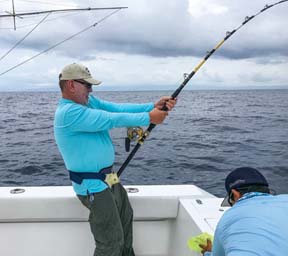

 their 600- foot pier. I did not fish on the pier, but I was tempted. I was told that there were big pargo down there, but I was so busy doing other things I did not have the time to try it.
 On day three which was our last full day there, Joe and I were booked to go inshore fishing and try for roosterfish.
  We were on a smaller 25’ Whaler since we were going inshore. It was a beautiful and comfortable boat. The weather looked like it could be nasty as there were many clouds and just had the feeling of rain. Once we got on the water and were out for 10 minutes we could see rain all over the water but for some reason it was leaving us alone. It was all around us like we had a cone over us. Not 30 minutes from the dock at Crocodile Bay Resort we started trolling live bait about 200 yards off the coast for roosterfish. After about a half hour of this with no bites I grabbed a spinning reel with a popper and gave that a try. It took about an hour into our fishing but a roosterfish (the one on the cover) finally got fooled on the troll and I quickly jumped up and went to battle with the 15-20 pound or so roosterfish. When I was here 18 years ago I caught one over 50 pounds and can still remember what a great fight that was. This guy for his size was quite feisty and did not want to come in but after about 5 minutes I got him to the boat. After a couple of photos that Joe should be proud of the rooster was carefully released.


 Having been born in Ukraine, I grew up hearing about the joys of carp fishing from my grandpa, my dad and their friends who still practice their traditional methods here on the lakes of southern California. However, I wanted to hear more about the modern techniques, directly from the anglers pursuing these monster carp under the radar locally. I recently linked up with David Smith, an avid carp angler from the UK, who is now living in Riverside county and his buddy Patrick, a life long Californian fisherman who’s recently fallen in love with these new angling techniques and thrill of carp fishing. Interestingly, David is an owner of a bait company by the name of CarpPro, that supplies this growing group of enthusiasts with some of the products necessary to catch one of these monsters. I’ll touch more on that later!
 The guys had decided on one of the many local waters that are known to contain a healthy population of carp for our session. Immediately, I’m struck by the tackle these guys are using. Long 12ft rods and large surf casting reels are standard issue to propel large dough balls the many yards necessary to reach the fish. “Being bank anglers, you a need a rod that has the ability to cast a heavy bait ball to the fish, which sometimes means over a distance of 100+ yards,” explained David. “Carp often tell you where they are by jumping and rolling, something that should never be ignored. Nothings more infuriating than seeing a fish and not being able to get to him!” he said. I watched him cast a float and sinker combo that allowed him to determine the depth and nature of the bottom, at a spot where leaping fish had been seen. “We’re attempting to understand what’s down at the bottom so we know how to present a bait and use the line clip on the reel to cast to the same spot every time by carefully determining the range” added David. Developing a “spot” is key to successful carp angling the guys told me, especially here in California where chumming to create a feeding zone isn’t allowed.
 Now that they have established their spot, we’ll move on to the bait and hooking arrangements. Like many traditional carp angling techniques, things are focused largely on the way carp feed by sucking up and blowing around as they vacuum up food from the lake or river bed.
 Before we even got on the boat, the Tuna War participants from the Tomahawk and Tribute, were getting back from their trip and were at the landing. Of course, we had to have pictures taken with the Wicked Tuna stars, Captain Dave Marciano and Captain Paul Hebert. This only created more excitement.
 Our adventure was to be an overnight on The Voyager with Captain Todd Myers at the helm. Todd and his crew, RJ and Chuck, were about to experience what many crews don’t get to. Fifteen lovely ladies who are biting at the bit to get out on the water and catch some fish. All of our tackle was ready to go and our first stop was to get bait.
 We headed to the Coronado Islands to catch some yellowtail and anything else that would bite. The Voyager arrived at 4:30am and several ladies got up to fish. They were calico fishing and it was off the hook. Every cast they caught a fish. “Waking up with these lassies at 4:30 in the morning next to the island catching bass until sunrise was my favorite part of the trip” said Donna. Hookup Baits, various plastics and sardines were what the bass were gorging themselves on.
 The sun rose and so did everyone who was still sleeping. Captain Todd took off to find some yellowtail. They were all around the Coronados, so they were easy to spot. The yellowtail were biting anything and everything. Charina surprisingly states, “I even caught one on a flatfall.” Sunny spent most of her day at the bow using her Seeker baby blue 9’3” rod with an Accurate Valiant 500 using a blue and white JRI jig to catch the majority of her fish. It was an incredible site to watch the yellowtail follow your lure as you reeled it in. As Casey puts it, “When everyone was hooked up on a yellowtail, the excitement was roaring.” Women have a tendency to scream when they’re hooked up to a fish. I know I do. Michelle puts it nicely, “It was a reunion of all women who come together and work together to help one another to fish and have fun.”
 My first fish was a huge bonito caught on my Accurate Valiant 300 using sardines. I’m the kind of angler who tries everything just for fun when fishing because you never know what the fish will bite. I tried a surface iron and almost landed the fish except it spit the hook. Using a yoyo setup wasn’t a good choice. The fish didn’t bite it at all. The hot ticket seemed to be the live bait which were sardines and that was what I landed my jackpot fish on. I caught all my yellowtail on them as did most of the other ladies.
 The sea lions were in full force as we fished. Jessica was hooked up with one of her many yellowtails and wouldn’t you know it, a seal lion tried to get it away from her. She fought hard for that fish and won. Jessica exclaimed, “When I got the yellowtail on the boat, there were no bite marks on it.” I didn’t get as lucky. The fish was at the boat with color and the deckhand tried to gaff it twice, but he missed both times. Out from under the boat in stealth mode, came a seal that must have been about 800lbs. He was the biggest one I think I’ve ever seen. He stole my fish and next thing you know my line is ripping off my reel. I stared at the deckhand in disbelief as I watched my line take off. The funny part is, I got all my line back and even the sliding sinker was there. The only thing missing was the hook. I hope it caused some pain to the seal’s stomach when he ate my fish.
 One thing about fishing with women is they encourage each other. If someone lost a fish, the others would say, “You’ll get them next time.” No one said anything negative about anyone or to anyone. We were there for each other no matter what. There were many levels of expertise on the boat, but we all did great and put the wood to the fish. “Imagine my surprise when we got on some yellowtail and all the women fished well. At one point I was fighting a fish and I looked down the rail and saw 4 women on fish weaving over and under, working together, yelling ‘color’ all over the place and successfully landing them all” said Rachel. We kept the deckhands on their toes and they definitely earned their keep that day.
 A funny thing happened to Ginger on the trip. She was fishing on the bow when she felt something poking her toe. She took off her boot, but didn’t see anything. She put it back on and the pain was even worse, then suddenly she saw a fish spine broken off in the top of her boot. At that exact moment, she landed a yellowtail. She threw her boot off and started winding it in on one foot while the deckhand worked to get the spine out. The deckhand got the boot back on her foot just in time for him to gaff her fish and this just happened to be the first yellowtail she ever caught.
 Water Clarity
 Time of Year
 That night, most of us got our gear ready for the morning while the boat got bait and began it’s journey to San Clemente. Ricardo Zepeda always helps me to set my drag and get my tackle together, so in the morning I don’t have to worry about it. Captain Andrew Viola was the night driver and drove us to the island safely.
 Oscar Ochoa was the hot stick on this trip. Every time I turned around, he was on a fish. He caught about 7 yellowtail and a variety of other fish. He could do no wrong. Joseph Wilson caught 3 yellows, and Brian Kelly, one of the deckhands, passed a yellowtail he hooked to Sydney Deturk. Watching her face while the fish was fighting was an awesome sight. Unfortunately, the fish won, but that happens. On her own, she managed to get a few bass. Another lady angler, hooked up to a yellowtail and it took her all the way around the boat. We all cheered her on as she reeled it in. All 3 ladies had a fish under their belt. Girl Power.
 Our bait choices were either sardine or squid. I hate picking up squid. Their tentacles give me the creeps. Ricardo always laughs at me as I attempt to grab one and drop it when it tries to grab me. Sometimes I get it on the hook and other times he hooks it on for me. I guess that’s one of the perks of being a female. Putting on a sardine is as easy as pie. It’s those crazy squid that get me.
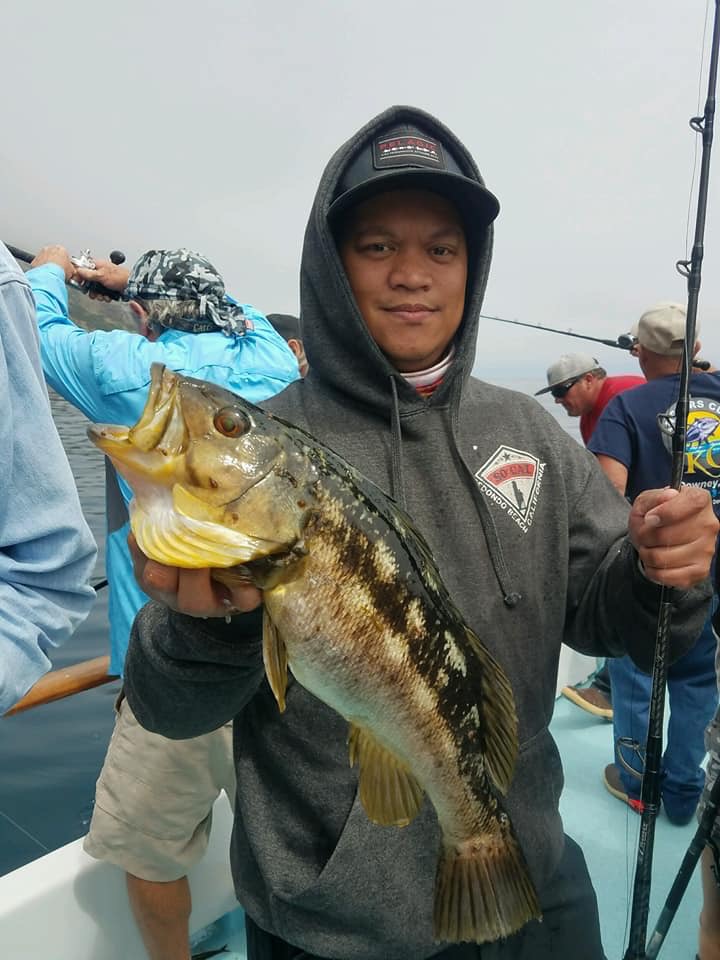
 We drove around San Clemente looking for fish and we stopped several times. One time, we found some bass. George Schewardz hooked up to a beautiful calico that gave him quite a fight. It was definitely a keeper. I caught a couple bass on a Hookup Bait, but none were as big as George’s.
 The trip was a success and everyone was happy with their catch. The crew always gives 100% and helps other anglers when they need it. I am pleased to say I won jackpot with my 32lb. yellowtail caught on a Moon’s custom rod 7.5 ft. Super Seeker with an Accurate Boss Xtreme 400 loaded with 65lb. spectra and 40lb. mono. Having a passion for a male dominated sport has never deterred me when it comes to fishing. I think other ladies should try it out. They might find that they love it as much as I do, and I would be willing to help them out anyway I can. Tails up!
 Big Blue Charters have caught numerous halibut well over 300 pounds over the years and my halibut made Captain Mike Keating shrug his shoulders like no big deal but that fish was one for the books for me. It was caught on an Avet reel and a Whopper Stopper built rod. One of the benefits of fishing with Big Blue Charters is that you know you will be using quality equipment and you don’t have to lug your own stuff on the plane. That way hopefully your luggage going home will be boxes of flash frozen filets from the tasty fish that inhabit the waters of Sitka.
 Another advantage of fishing with Big Blue Charters are their very comfy BAMF boats that have an inside cabin that seat 7 or 8 on the way to the fishing grounds. Also, this year they upgraded their sonar with some of the most up to date products available from Simrad. Mike Keating was like a kid in a candy store playing with it and marking spots. He was really excited about mastering it this summer and knowing to the “T” where all his good fishing spots are.
 Even if I had not caught the personal best halibut that day it still would have been one of my best fishing days ever. Part of fishing is having fun and fishing with Captains Jesse Graham and Mike Keating of Big Blue Charters, Ed Robison of Whopper Stoppers, Raymond McCullough and Vinny Peters an ex-deckhand for Big Blue Charters is fun. The days we were fishing were non- charter days so we just had a bunch of guys having fun. In fact, the only person who could have made it more fun was Big Blue Charters deckhand Emmitt Andersen. This outstanding young man had to miss the fishing though as he is part of the Sitka High School baseball team playing in the state finals that week that made a Hoosiers (reference 1980’s film about Indiana basketball) like run in winning the Alaska state baseball championship over a much larger and highly touted Anchorage high school. Congrats Emmitt.
 Ed of Whopper Stoppers builds some of the finest rods available and his booth is always jam-packed at the Fred Hall show. Ed is a good guy and a good guy to fish with. Since this was a trip of friends there was lots of ribbing going on. LOTS. Any mistake was magnified. Ed took it all in like it was no big deal.
 The three days of fishing produced numerous halibut in the 30 to 70 range, some large lingcod that we had to release and some we kept that fit the slot limit and limits of yelloweye and black bass each day. And while the salmon fishing was a little slower than normal (plus we farmed a few) we spent more time targeting bottom fish than normal. Captain Keating is one of the best and most determined captains I know and as always put us on the fish. Fishing with Big Blue Charters is always a highlight for me and I am already looking forward to next year. Hopefully when I go no one will give me a basket of strawberries.
 Carolina rigging consists of a sliding egg sinker, bead, swivel, 18”-36” fluorocarbon leader and a hook. In small surf a ½ ounce egg sinker works well. In bigger surf or when fishing in the wind use a ½ – 1-ounce or sinker to keep your bait on the bottom.